Household hydrogen peroxide is an aqueous solution containing 3.0% hydrogen peroxide by mass. What is the molarity of this solution? (Assume a density of 1.01 g/mL.)
Ch.13 - Solutions
Tro4th EditionChemistry: A Molecular ApproachISBN: 9780134112831Non è quello che usi tu?Cambia libro di testo
Capitolo 13, Problema 67
An aqueous solution contains 36% HCl by mass. Calculate the molality and mole fraction of the solution.
Guida verificata passo dopo passo1
Identify the given information: 36% HCl by mass means 36 grams of HCl in 100 grams of solution.
Calculate the mass of the solvent (water) by subtracting the mass of HCl from the total mass of the solution: 100 g - 36 g = 64 g of water.
Convert the mass of HCl to moles using its molar mass (Molar mass of HCl = 1.01 g/mol for H + 35.45 g/mol for Cl = 36.46 g/mol).
Convert the mass of water to kilograms to use in the molality formula (1 kg = 1000 g).
Calculate the molality using the formula: molality (m) = moles of solute / kilograms of solvent, and calculate the mole fraction using the formula: mole fraction of HCl = moles of HCl / (moles of HCl + moles of water).

Risposta video verificata per un problema simile:
Questa soluzione video è stata consigliata dai nostri tutor come utile per risolvere questo problema.
Durata del video:
4mConcetti chiave
Ecco i concetti essenziali che devi comprendere per rispondere correttamente alla domanda.
Molality
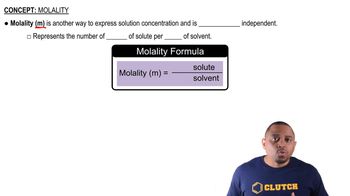
Molality is a measure of the concentration of a solute in a solution, defined as the number of moles of solute per kilogram of solvent. It is particularly useful in situations where temperature changes may affect volume, as it is based on mass rather than volume. To calculate molality, one must first determine the moles of solute and the mass of the solvent in kilograms.
Video consigliato:
Percorso guidato
Molality
Mole Fraction
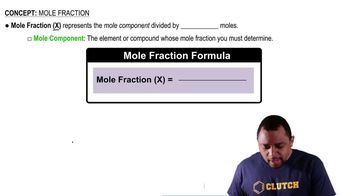
Mole fraction is a way to express the concentration of a component in a mixture, defined as the ratio of the number of moles of that component to the total number of moles of all components in the mixture. It is a dimensionless quantity and is useful for understanding the composition of solutions. To find the mole fraction, one must calculate the moles of both the solute and the solvent.
Video consigliato:
Percorso guidato
Mole Fraction Formula
Mass Percent
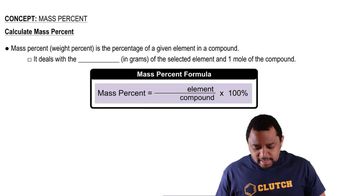
Mass percent, or weight percent, is a way to express the concentration of a solute in a solution, calculated as the mass of the solute divided by the total mass of the solution, multiplied by 100. In this case, a 36% mass percent of HCl means that there are 36 grams of HCl in every 100 grams of solution. This information is crucial for converting mass to moles and subsequently calculating molality and mole fraction.
Video consigliato:
Percorso guidato
Mass Percent Calculation
Pratica correlata
Domanda del libro di testo
1802
views
1
rank
Domanda del libro di testo
A solution is prepared by dissolving 20.2 mL of methanol (CH3OH) in 100.0 mL of water at 25 °C. The final volume of the solution is 118 mL. The densities of methanol and water at this temperature are 0.782 g/mL and 1.00 g/mL, respectively. For this solution, calculate the concentration in each unit. e. mole percent
334
views
Domanda del libro di testo
One brand of laundry bleach is an aqueous solution containing 4.55% sodium hypochlorite (NaOCl) by mass. What is the molarity of this solution? (Assume a density of 1.02 g/mL.)
1822
views
2
rank
Domanda del libro di testo
Which solution has the highest vapor pressure? a. 20.0 g of glucose (C6H12O6) in 100.0 mL of water b. 20.0 g of sucrose (C12H22O11) in 100.0 mL of water c. 10.0 g of potassium acetate KC2H3O2 in 100.0 mL of water
2052
views
1
comments