
Ch.13 - Solutions
Tro - Chemistry: A Molecular Approach 4th Edition
Tro4th EditionChemistry: A Molecular ApproachISBN: 9780134112831Non è quello che usi tu?Cambia libro di testo
Capitolo 13, Problema 30a,c,d

Pick an appropriate solvent from Table 13.3 to dissolve each substance. State the kind of intermolecular forces that would occur between the solute and solvent in each case. a. isopropyl alcohol (polar, contains an OH group) c. vegetable oil (nonpolar) d. sodium nitrate (ionic)

Guida verificata passo dopo passo
1
Identify the type of intermolecular forces present in isopropyl alcohol, which is polar and contains an OH group. These forces include hydrogen bonding and dipole-dipole interactions.
Select a solvent for isopropyl alcohol that can engage in similar intermolecular forces. A polar solvent with hydrogen bonding capability, such as water, would be appropriate.
Consider the nature of vegetable oil, which is nonpolar. The primary intermolecular forces are London dispersion forces.
Choose a solvent for vegetable oil that is also nonpolar, allowing for London dispersion forces to dominate. A nonpolar solvent like hexane would be suitable.
Examine sodium nitrate, an ionic compound. The key intermolecular forces are ion-dipole interactions.
Select a solvent for sodium nitrate that can stabilize ions through ion-dipole interactions. A polar solvent like water would be effective.

Risposta video verificata per un problema simile:

Questa soluzione video è stata consigliata dai nostri tutor come utile per risolvere questo problema.
Durata del video:
2m

Concetti chiave

Ecco i concetti essenziali che devi comprendere per rispondere correttamente alla domanda.

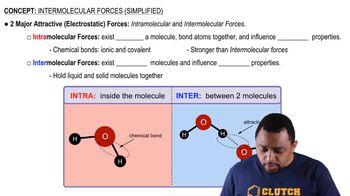
Intermolecular Forces

Intermolecular forces are the forces of attraction or repulsion between molecules. They play a crucial role in determining the physical properties of substances, such as boiling and melting points. The main types of intermolecular forces include hydrogen bonding, dipole-dipole interactions, and London dispersion forces. Understanding these forces helps predict how different substances will interact when mixed.
Video consigliato:
Percorso guidato
01:59
Intermolecular vs Intramolecular Forces

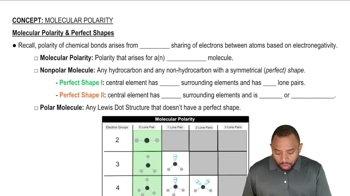
Polarity

Polarity refers to the distribution of electrical charge over the atoms in a molecule. Polar molecules, like isopropyl alcohol, have a significant difference in electronegativity between their atoms, leading to a partial positive and negative charge. Nonpolar molecules, such as vegetable oil, have an even distribution of charge. The principle 'like dissolves like' indicates that polar solvents dissolve polar solutes, while nonpolar solvents dissolve nonpolar solutes.
Video consigliato:
Percorso guidato
02:38
Molecular Polarity

Ionic Compounds and Solubility

Ionic compounds, such as sodium nitrate, consist of positively and negatively charged ions. Their solubility in solvents depends on the solvent's ability to stabilize these ions in solution. Polar solvents, particularly water, can effectively dissolve ionic compounds due to their strong dipole interactions, which help separate and surround the ions. This process is essential for understanding how ionic substances behave in different solvent environments.
Video consigliato:
Percorso guidato
02:11
Ionic Compounds Naming