
Ch.14 - Chemical Kinetics
Tro - Chemistry: A Molecular Approach 4th Edition
Tro4th EditionChemistry: A Molecular ApproachISBN: 9780134112831Non è quello che usi tu?Cambia libro di testo
Capitolo 14, Problema 39b

A reaction in which A, B, and C react to form products is first order in A, second order in B, and zero order in C. b. What is the overall order of the reaction?

Guida verificata passo dopo passo
1
Identify the order of the reaction with respect to each reactant: first order in A, second order in B, and zero order in C.
Recall that the overall order of a reaction is the sum of the orders with respect to each reactant.
Add the orders of the reactants: first order (A) + second order (B) + zero order (C).
Calculate the sum: 1 (from A) + 2 (from B) + 0 (from C).
The overall order of the reaction is the result of this sum.

Risposta video verificata per un problema simile:

Questa soluzione video è stata consigliata dai nostri tutor come utile per risolvere questo problema.
Durata del video:
56s

Concetti chiave

Ecco i concetti essenziali che devi comprendere per rispondere correttamente alla domanda.

Reaction Order

The reaction order is a key concept in chemical kinetics that indicates the relationship between the concentration of reactants and the rate of the reaction. It is determined by the sum of the powers of the concentration terms in the rate law. For example, if a reaction is first order in A and second order in B, the overall order is the sum of these orders.
Video consigliato:
Percorso guidato
00:36
Average Bond Order

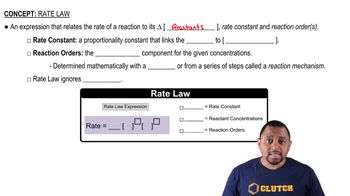
Rate Law

The rate law expresses the rate of a chemical reaction as a function of the concentration of its reactants, each raised to a power corresponding to its order in the reaction. The general form is Rate = k[A]^m[B]^n[C]^p, where k is the rate constant, and m, n, and p are the orders with respect to reactants A, B, and C, respectively. Understanding the rate law is essential for determining the overall order of the reaction.
Video consigliato:
Percorso guidato
01:52
Rate Law Fundamentals

Zero Order Reactions

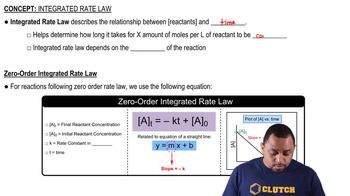
In zero order reactions, the rate of reaction is independent of the concentration of the reactant. This means that changes in the concentration of a zero-order reactant do not affect the rate of the reaction. In the given question, since C is zero order, it does not contribute to the overall order, which is calculated solely from the other reactants.
Video consigliato:
Percorso guidato
02:44
Zero-Order Reactions
Pratica correlata
Domanda del libro di testo

A reaction in which A, B, and C react to form products is first order in A, second order in B, and zero order in C c. By what factor does the reaction rate change if [A] is doubled (and the other reactant concentrations are held constant)? d. By what factor does the reaction rate change if [B] is doubled (and the other reactant concentrations are held constant)? e. By what factor does the reaction rate change if [C] is doubled? f. By what factor does the reaction rate change if the concentrations of all three reactants are doubled?

858
views
Domanda del libro di testo

A reaction in which A, B, and C react to form products is zero order in A, one-half order in B, and second order in C. a. Write a rate law for the reaction.

833
views
Domanda del libro di testo

This reaction is first order in N2O5: N2O5(g) → NO3(g) + NO2(g) The rate constant for the reaction at a certain temperature is 0.053/s. a. Calculate the rate of the reaction when [N2O5] = 0.055 M

531
views
Domanda del libro di testo

A reaction in which A, B, and C react to form products is first order in A, second order in B, and zero order in C.

a. Write a rate law for the reaction.

Domanda del libro di testo

This reaction is first order in N2O5: N2O5(g) → NO3(g) + NO2(g) The rate constant for the reaction at a certain temperature is 0.053/s. b. What would the rate of the reaction be at the concentration indicated in part a if the reaction were second order? Zero order? (Assume the same numerical value for the rate constant with the appropriate units.)

2748
views
1
rank