
Ch.14 - Chemical Kinetics
Tro - Chemistry: A Molecular Approach 4th Edition
Tro4th EditionChemistry: A Molecular ApproachISBN: 9780134112831Non è quello che usi tu?Cambia libro di testo
Capitolo 14, Problema 40c,d,e,f

A reaction in which A, B, and C react to form products is zero order in A, one-half order in B, and second order in C. c. By what factor does the reaction rate change if [A] is doubled (and the other reactant concentrations are held constant)? d. By what factor does the reaction rate change if [B] is doubled? e. By what factor does the reaction rate change if [C] is doubled? f. By what factor does the reaction rate change if [C] is doubled (and the other reactant concentrations are held constant)?

Guida verificata passo dopo passo
1
Identify the rate law expression for the reaction: \( \text{Rate} = k[A]^0[B]^{1/2}[C]^2 \).
Recognize that the reaction is zero order in A, meaning changes in [A] do not affect the rate.
Understand that the reaction is one-half order in B, meaning the rate is proportional to the square root of [B].
Note that the reaction is second order in C, meaning the rate is proportional to the square of [C].
Calculate the factor by which the rate changes when [C] is doubled: \( \left(2[C]\right)^2 = 4[C]^2 \), so the rate increases by a factor of 4.

Risposta video verificata per un problema simile:

Questa soluzione video è stata consigliata dai nostri tutor come utile per risolvere questo problema.

Concetti chiave

Ecco i concetti essenziali che devi comprendere per rispondere correttamente alla domanda.

Order of Reaction

The order of a reaction refers to the power to which the concentration of a reactant is raised in the rate law. It indicates how the rate of reaction is affected by the concentration of that reactant. In this case, the reaction is zero order in A, one-half order in B, and second order in C, meaning that changes in the concentration of A do not affect the rate, while B and C do, with C having the most significant impact.
Video consigliato:
Percorso guidato
00:36
Average Bond Order

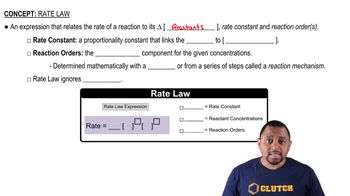
Rate Law

The rate law expresses the relationship between the rate of a chemical reaction and the concentrations of its reactants. It is typically written in the form Rate = k[A]^m[B]^n[C]^p, where k is the rate constant, and m, n, and p are the orders of the reaction with respect to each reactant. For this reaction, the rate law can be expressed as Rate = k[B]^(1/2)[C]^2, highlighting how the rate depends on the concentrations of B and C.
Video consigliato:
Percorso guidato
01:52
Rate Law Fundamentals

Effect of Concentration Change on Reaction Rate

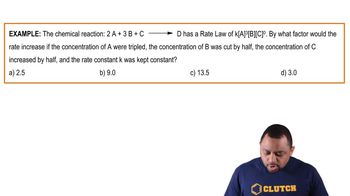
When the concentration of a reactant is changed, the reaction rate changes according to its order. For example, if the concentration of C is doubled in this reaction, the rate will increase by a factor of 2^2 (since C is second order), resulting in a fourfold increase in the reaction rate. This principle is crucial for predicting how changes in reactant concentrations will affect the overall speed of the reaction.
Video consigliato:
Percorso guidato
02:10
Concentration Changes and Rate Law Example