Ch.14 - Chemical Kinetics
Tro - Chemistry: A Molecular Approach 4th Edition
Tro4th EditionChemistry: A Molecular ApproachISBN: 9780134112831Non è quello che usi tu?Cambia libro di testo
Capitolo 14, Problema 63

The rate constant (k) for a reaction was measured as a function of temperature. A plot of ln k versus 1/T (in K) is linear and has a slope of -7445 K. Calculate the activation energy for the reaction.

Guida verificata passo dopo passo
1
Identify the relationship between the slope of the plot and the activation energy using the Arrhenius equation: \( \ln k = \ln A - \frac{E_a}{R} \cdot \frac{1}{T} \).
Recognize that the slope of the plot \( \ln k \) versus \( \frac{1}{T} \) is equal to \( -\frac{E_a}{R} \), where \( E_a \) is the activation energy and \( R \) is the universal gas constant.
Use the given slope of the plot, which is -7445 K, and set it equal to \( -\frac{E_a}{R} \).
Solve for the activation energy \( E_a \) by rearranging the equation: \( E_a = -\text{slope} \times R \).
Substitute the value of the universal gas constant \( R = 8.314 \text{ J/mol K} \) into the equation to find \( E_a \).

Risposta video verificata per un problema simile:

Questa soluzione video è stata consigliata dai nostri tutor come utile per risolvere questo problema.

Concetti chiave

Ecco i concetti essenziali che devi comprendere per rispondere correttamente alla domanda.

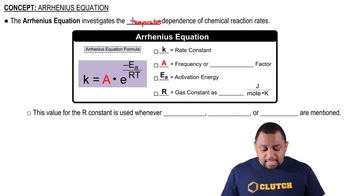
Arrhenius Equation

The Arrhenius equation relates the rate constant (k) of a chemical reaction to the temperature (T) and activation energy (Ea). It is expressed as k = A * e^(-Ea/RT), where A is the pre-exponential factor, R is the universal gas constant, and T is the temperature in Kelvin. This equation shows that as temperature increases, the rate constant typically increases, indicating a faster reaction.
Video consigliato:
Percorso guidato
01:20
Arrhenius Equation

Activation Energy (Ea)

Activation energy is the minimum energy required for a chemical reaction to occur. It represents the energy barrier that reactants must overcome to form products. A higher activation energy means that fewer molecules have sufficient energy to react at a given temperature, resulting in a slower reaction rate. It can be determined from the slope of a plot of ln k versus 1/T.
Video consigliato:
Percorso guidato
02:02
Activity Series Chart

Linear Relationship in ln k vs. 1/T

The linear relationship between ln k and 1/T indicates that the reaction follows the Arrhenius behavior. The slope of this line is equal to -Ea/R, where R is the gas constant. This linearity allows for the calculation of activation energy by rearranging the equation to Ea = -slope * R. In this case, the slope of -7445 K can be used to find the activation energy for the reaction.
Video consigliato:
Percorso guidato
02:43
Relationship between ∆E°, ∆G°, and K