
Ch.14 - Chemical Kinetics
Tro - Chemistry: A Molecular Approach 4th Edition
Tro4th EditionChemistry: A Molecular ApproachISBN: 9780134112831Non è quello che usi tu?Cambia libro di testo
Capitolo 14, Problema 33a(iii)

Consider the reaction: H2(g) + Br2(g) → 2 HBr(g) The graph shows the concentration of Br2 as a function of time. a. Use the graph to calculate each quantity: (iii) the instantaneous rate of formation of HBr at 50 s

Guida verificata passo dopo passo
1
Identify the relationship between the rate of disappearance of Br2 and the rate of formation of HBr from the balanced chemical equation: H2 + Br2 → 2 HBr. The stoichiometry shows that 1 mole of Br2 produces 2 moles of HBr.
Determine the instantaneous rate of disappearance of Br2 at 50 seconds by finding the slope of the tangent line to the concentration vs. time graph at that point. This slope represents - rac{d[\(\text{Br}\)_2]}{dt}.
Calculate the instantaneous rate of formation of HBr using the stoichiometric relationship: \(\text{rate of formation of HBr}\) = 2 imes \(\text{rate of disappearance of Br}\)_2.
Express the rate of formation of HBr as rac{d[\(\text{HBr}\)]}{dt} = 2 imes iggl(- rac{d[\(\text{Br}\)_2]}{dt}iggr), ensuring the rate is positive since it is a formation rate.
Summarize the result as the instantaneous rate of formation of HBr at 50 s, based on the slope obtained from the graph and the stoichiometric factor of 2.

Risposta video verificata per un problema simile:

Questa soluzione video è stata consigliata dai nostri tutor come utile per risolvere questo problema.
Durata del video:
4m

Concetti chiave

Ecco i concetti essenziali che devi comprendere per rispondere correttamente alla domanda.

Reaction Rate and Instantaneous Rate

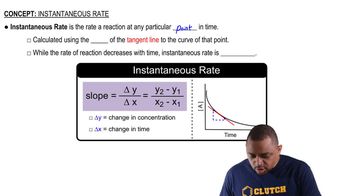
The reaction rate measures how fast reactants are consumed or products are formed. The instantaneous rate is the rate at a specific moment, found by calculating the slope of the concentration vs. time graph at that point, often using the tangent line.
Video consigliato:
Percorso guidato
01:30
Instantaneous Rate

Stoichiometry and Rate Relationships

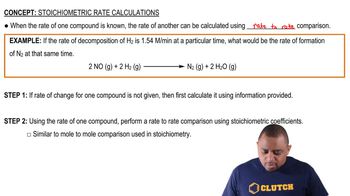
Stoichiometry relates the amounts of reactants and products in a chemical reaction. For the reaction H2 + Br2 → 2 HBr, the rate of formation of HBr is twice the rate of consumption of Br2, so rates must be adjusted according to their coefficients.
Video consigliato:
Percorso guidato
02:28
Stoichiometric Rate Calculations

Interpreting Concentration-Time Graphs

Concentration-time graphs show how reactant or product concentrations change over time. The slope of the curve at a given time gives the rate of change of concentration, which can be used to find instantaneous rates for reactants or products.
Video consigliato:
Percorso guidato
03:13
Intepreting the Band of Stability