
Ch.14 - Chemical Kinetics
Tro - Chemistry: A Molecular Approach 4th Edition
Tro4th EditionChemistry: A Molecular ApproachISBN: 9780134112831Non è quello che usi tu?Cambia libro di testo
Capitolo 14, Problema 102b

Consider the two reactions:
O + N2 → NO + N Ea = 315 kJ/mol
Cl + H2 → HCl + H Ea = 23 kJ/mol
b. The frequency factors for these two reactions are very close to each other in value. Assuming that they are the same, calculate the ratio of the reaction rate constants for these two reactions at 25 °C.

Guida verificata passo dopo passo
1
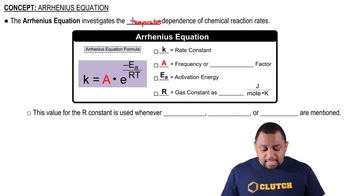
Identify the Arrhenius equation: \( k = A e^{-\frac{E_a}{RT}} \), where \( k \) is the rate constant, \( A \) is the frequency factor, \( E_a \) is the activation energy, \( R \) is the gas constant (8.314 J/mol·K), and \( T \) is the temperature in Kelvin.
Convert the temperature from Celsius to Kelvin: \( T = 25 + 273.15 = 298.15 \text{ K} \).
Since the frequency factors \( A \) are assumed to be the same for both reactions, the ratio of the rate constants \( \frac{k_1}{k_2} \) can be expressed as \( \frac{e^{-\frac{E_{a1}}{RT}}}{e^{-\frac{E_{a2}}{RT}}} = e^{-\frac{E_{a1} - E_{a2}}{RT}} \).
Substitute the given activation energies into the equation: \( E_{a1} = 315 \text{ kJ/mol} = 315,000 \text{ J/mol} \) and \( E_{a2} = 23 \text{ kJ/mol} = 23,000 \text{ J/mol} \).
Calculate the exponent: \( -\frac{(315,000 - 23,000)}{8.314 \times 298.15} \) and use this to find the ratio \( \frac{k_1}{k_2} = e^{\text{calculated exponent}} \).

Risposta video verificata per un problema simile:

Questa soluzione video è stata consigliata dai nostri tutor come utile per risolvere questo problema.
Durata del video:
4m

Concetti chiave

Ecco i concetti essenziali che devi comprendere per rispondere correttamente alla domanda.

Arrhenius Equation

The Arrhenius equation describes how the rate constant of a chemical reaction depends on temperature and activation energy. It is expressed as k = A * e^(-Ea/RT), where k is the rate constant, A is the frequency factor, Ea is the activation energy, R is the universal gas constant, and T is the temperature in Kelvin. This equation highlights the exponential relationship between temperature and reaction rates, indicating that higher temperatures generally lead to faster reactions.
Video consigliato:
Percorso guidato
01:20
Arrhenius Equation

Activation Energy (Ea)

Activation energy is the minimum energy required for a chemical reaction to occur. It represents the energy barrier that reactants must overcome to transform into products. In the context of the given reactions, the activation energies of 315 kJ/mol and 23 kJ/mol indicate that the first reaction is significantly more energy-intensive than the second, which affects their respective reaction rates at a given temperature.
Video consigliato:
Percorso guidato
02:02
Activity Series Chart

Reaction Rate Constant (k)

The reaction rate constant (k) is a proportionality factor that relates the rate of a reaction to the concentrations of the reactants. It is influenced by factors such as temperature and activation energy. In the context of the question, calculating the ratio of the rate constants for the two reactions involves using the Arrhenius equation, allowing for a comparison of how the different activation energies impact the overall reaction rates at 25 °C.
Video consigliato:
Percorso guidato
01:14
Equilibrium Constant K