Ch.14 - Chemical Kinetics
Tro - Chemistry: A Molecular Approach 4th Edition
Tro4th EditionChemistry: A Molecular ApproachISBN: 9780134112831Non è quello che usi tu?Cambia libro di testo
Capitolo 14, Problema 77b

Consider this three-step mechanism for a reaction:
Cl2 (g) k1⇌k2 2 Cl (g) Fast
Cl (g) + CHCl3 (g) →k3 HCl (g) + CCl3 (g) Slow
Cl (g) + CCl3 (g) →k4 CCl4 (g) Fast
b. Identify the intermediates in the mechanism.

Guida verificata passo dopo passo
1
Intermediates are species that are produced in one step of a reaction mechanism and consumed in a subsequent step.
Examine each step of the mechanism to identify species that are not present in the overall balanced equation.
In the first step, Cl2 dissociates into 2 Cl atoms.
In the second step, Cl reacts with CHCl3 to form HCl and CCl3.
In the third step, Cl reacts with CCl3 to form CCl4.

Risposta video verificata per un problema simile:

Questa soluzione video è stata consigliata dai nostri tutor come utile per risolvere questo problema.
Durata del video:
1m

Concetti chiave

Ecco i concetti essenziali che devi comprendere per rispondere correttamente alla domanda.

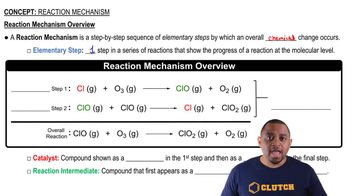
Reaction Mechanism

A reaction mechanism is a step-by-step description of how a chemical reaction occurs at the molecular level. It outlines the sequence of elementary steps that lead to the overall reaction, including the formation and consumption of intermediates. Understanding the mechanism helps in predicting the rate and outcome of the reaction.
Video consigliato:
Percorso guidato
03:06
Reaction Mechanism Overview

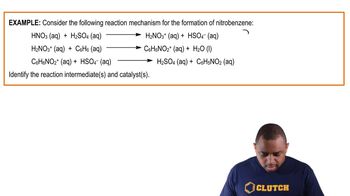
Intermediates

Intermediates are species that are formed during the reaction mechanism but are not present in the final products. They are typically unstable and exist only for a short duration before being converted into products. Identifying intermediates is crucial for understanding the pathway of the reaction and its kinetics.
Video consigliato:
Percorso guidato
02:14
Reaction Mechanism Example

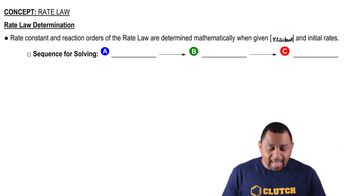
Rate-Determining Step

The rate-determining step is the slowest step in a reaction mechanism that controls the overall reaction rate. It is the step that has the highest activation energy and thus takes the longest time to occur. Recognizing the rate-determining step is essential for predicting how changes in conditions will affect the reaction rate.
Video consigliato:
Percorso guidato
01:15
Rate Law Determination