Ch.14 - Chemical Kinetics
Tro - Chemistry: A Molecular Approach 4th Edition
Tro4th EditionChemistry: A Molecular ApproachISBN: 9780134112831Non è quello che usi tu?Cambia libro di testo
Capitolo 14, Problema 112a

Ethyl chloride vapor decomposes by the first-order reaction: C2H5Cl → C2H4 + HCl The activation energy is 249 kJ/mol, and the frequency factor is 1.6⨉1014 s-1. Find the value of the rate constant at 710 K.

Guida verificata passo dopo passo
1
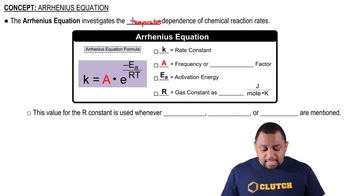
Identify the Arrhenius equation: k = A \(\cdot\) e^{-\(\frac{E_a}{RT}\)}.
Substitute the given values into the Arrhenius equation: A = 1.6 \(\times\) 10^{14} \(\text{s}\)^{-1}, E_a = 249 \(\text{kJ/mol}\), T = 710 \(\text{K}\).
Convert the activation energy from kJ/mol to J/mol: E_a = 249 \(\times\) 10^3 \(\text{J/mol}\).
Use the gas constant R = 8.314 \(\text{J/mol}\) \(\cdot\) \(\text{K}\) in the equation.
Calculate the exponent: -\(\frac{E_a}{RT}\) and then find the rate constant k by evaluating the Arrhenius equation.

Risposta video verificata per un problema simile:

Questa soluzione video è stata consigliata dai nostri tutor come utile per risolvere questo problema.
Durata del video:
3m

Concetti chiave

Ecco i concetti essenziali che devi comprendere per rispondere correttamente alla domanda.

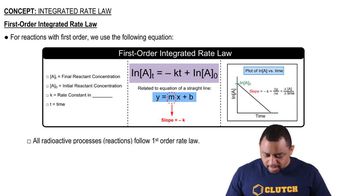
First-Order Reactions

First-order reactions are chemical reactions where the rate is directly proportional to the concentration of one reactant. This means that if the concentration of the reactant doubles, the rate of the reaction also doubles. The rate law for a first-order reaction can be expressed as rate = k[A], where k is the rate constant and [A] is the concentration of the reactant.
Video consigliato:
Percorso guidato
02:29
First-Order Reactions

Arrhenius Equation

The Arrhenius equation relates the rate constant of a reaction to the temperature and activation energy. It is expressed as k = A * e^(-Ea/RT), where k is the rate constant, A is the frequency factor, Ea is the activation energy, R is the universal gas constant, and T is the temperature in Kelvin. This equation shows how temperature influences reaction rates, with higher temperatures generally leading to increased rates.
Video consigliato:
Percorso guidato
01:20
Arrhenius Equation

Activation Energy

Activation energy (Ea) is the minimum energy required for a chemical reaction to occur. It represents the energy barrier that reactants must overcome to transform into products. A higher activation energy indicates that fewer molecules have sufficient energy to react at a given temperature, thus affecting the rate of the reaction. In the context of the Arrhenius equation, a higher Ea results in a smaller rate constant at lower temperatures.
Video consigliato:
Percorso guidato
02:02
Activity Series Chart