Ch.14 - Chemical Kinetics
Tro - Chemistry: A Molecular Approach 4th Edition
Tro4th EditionChemistry: A Molecular ApproachISBN: 9780134112831Non è quello che usi tu?Cambia libro di testo
Capitolo 14, Problema 27a

For the reaction 2 A(g) + B(g) → 3 C(g), a. Determine the expression for the rate of the reaction in terms of the change in concentration of each of the reactants and products.

Guida verificata passo dopo passo
1
Start by understanding that the rate of a reaction is defined as the change in concentration of a reactant or product per unit time.
For the given reaction 2 A(g) + B(g) → 3 C(g), identify the stoichiometric coefficients: 2 for A, 1 for B, and 3 for C.
The rate of disappearance of a reactant is negative, while the rate of appearance of a product is positive.
Write the rate expression for each species: Rate = -\(\frac{1}{2}\)\(\frac{d[A]}{dt}\) = -\(\frac{d[B]}{dt}\) = \(\frac{1}{3}\)\(\frac{d[C]}{dt}\).
These expressions ensure that the rate of the reaction is the same regardless of which species' concentration change is being measured.

Risposta video verificata per un problema simile:

Questa soluzione video è stata consigliata dai nostri tutor come utile per risolvere questo problema.
Durata del video:
2m

Concetti chiave

Ecco i concetti essenziali che devi comprendere per rispondere correttamente alla domanda.

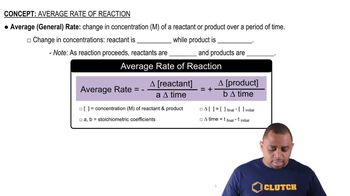
Rate of Reaction

The rate of a chemical reaction is a measure of how quickly reactants are converted into products. It is typically expressed as the change in concentration of a reactant or product per unit time. For a reaction, the rate can be influenced by factors such as temperature, concentration, and the presence of catalysts.
Video consigliato:
Percorso guidato
02:03
Average Rate of Reaction

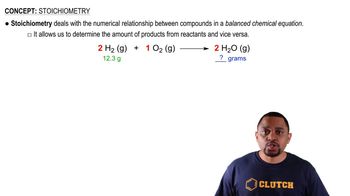
Stoichiometry

Stoichiometry involves the quantitative relationships between the amounts of reactants and products in a chemical reaction, as dictated by the balanced chemical equation. In the given reaction, the coefficients indicate the molar ratios of A, B, and C, which are essential for determining how changes in concentration affect the rate of the reaction.
Video consigliato:
Percorso guidato
01:16
Stoichiometry Concept

Change in Concentration

The change in concentration refers to the difference in the concentration of a substance over a specific time interval. In the context of the reaction, it is crucial to express the rate in terms of the changes in concentration of both reactants and products, allowing for a comprehensive understanding of how the reaction progresses over time.
Video consigliato:
Percorso guidato
01:53
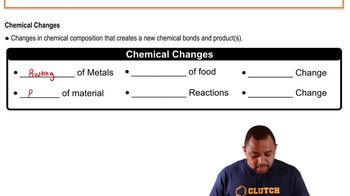
Chemical Changes