
Ch.14 - Chemical Kinetics
Tro - Chemistry: A Molecular Approach 4th Edition
Tro4th EditionChemistry: A Molecular ApproachISBN: 9780134112831Non è quello che usi tu?Cambia libro di testo
Capitolo 14, Problema 47

Indicate the order of reaction consistent with each observation. a. A plot of the concentration of the reactant versus time yields a straight line. Indicate the order of reaction consistent with each observation b. The reaction has a half-life that is independent of initial concentration. c. A plot of the inverse of the concentration versus time yields a straight line.

Guida verificata passo dopo passo
1
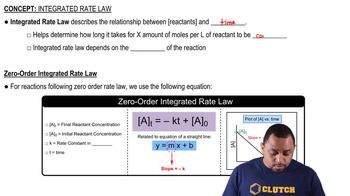
For part (a), recognize that a plot of concentration versus time yielding a straight line indicates a zero-order reaction. In a zero-order reaction, the rate of reaction is constant and does not depend on the concentration of the reactant.
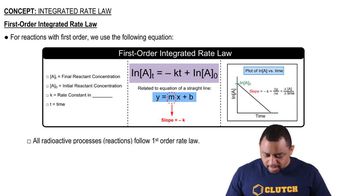
For part (b), understand that a reaction with a half-life independent of initial concentration is characteristic of a first-order reaction. In a first-order reaction, the half-life is constant and does not change with varying initial concentrations.
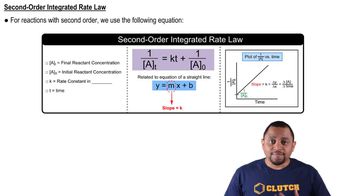
For part (c), identify that a plot of the inverse of concentration versus time yielding a straight line suggests a second-order reaction. In a second-order reaction, the rate is proportional to the square of the concentration of the reactant.
To summarize, the order of reaction can be determined by analyzing the relationship between concentration and time, as well as the behavior of the half-life.
These observations help in understanding the kinetics of the reaction and determining the rate law.

Risposta video verificata per un problema simile:

Questa soluzione video è stata consigliata dai nostri tutor come utile per risolvere questo problema.
Durata del video:
1m

Concetti chiave

Ecco i concetti essenziali che devi comprendere per rispondere correttamente alla domanda.

Zero-Order Reactions

In zero-order reactions, the rate of reaction is constant and does not depend on the concentration of the reactants. A plot of reactant concentration versus time yields a straight line with a negative slope, indicating that the concentration decreases linearly over time. This behavior is typical for reactions where a catalyst is saturated or when the reaction mechanism is limited by a surface reaction.
Video consigliato:
Percorso guidato
02:44
Zero-Order Reactions

First-Order Reactions

First-order reactions are characterized by a rate that is directly proportional to the concentration of one reactant. The half-life of a first-order reaction is independent of the initial concentration, meaning it remains constant regardless of how much reactant is present. This relationship is crucial for understanding the kinetics of many biochemical and pharmaceutical processes.
Video consigliato:
Percorso guidato
02:29
First-Order Reactions

Second-Order Reactions

Second-order reactions can involve either one reactant squared or two different reactants. A plot of the inverse of the concentration of the reactant versus time yields a straight line, indicating that the rate of reaction depends on the square of the concentration. This type of reaction often occurs in bimolecular processes, where two reactant molecules collide to form products.
Video consigliato:
Percorso guidato
01:59
Second-Order Reactions