Ch.14 - Chemical Kinetics
Tro - Chemistry: A Molecular Approach 4th Edition
Tro4th EditionChemistry: A Molecular ApproachISBN: 9780134112831Non è quello che usi tu?Cambia libro di testo
Capitolo 14, Problema 82

The activation barrier for the hydrolysis of sucrose into glucose and fructose is 108 kJ/mol. If an enzyme increases the rate of the hydrolysis reaction by a factor of 1 million, how much lower must the activation barrier be when sucrose is in the active site of the enzyme? (Assume that the frequency factors for the catalyzed and uncatalyzed reactions are identical and a temperature of 25 °C.)

Guida verificata passo dopo passo
1
Identify the given information: the activation energy for the uncatalyzed reaction is 108 kJ/mol, the rate increase factor is 1 million, and the temperature is 25 °C.
Use the Arrhenius equation: k = A * e^(-Ea/(RT)), where k is the rate constant, A is the frequency factor, Ea is the activation energy, R is the gas constant (8.314 J/(mol·K)), and T is the temperature in Kelvin.
Convert the temperature from Celsius to Kelvin: T = 25 + 273.15 = 298.15 K.
Set up the ratio of the rate constants for the catalyzed (k_cat) and uncatalyzed (k_uncat) reactions: k_cat / k_uncat = 1,000,000 = e^(-(Ea_cat - Ea_uncat)/(RT)).
Solve for the difference in activation energies (Ea_uncat - Ea_cat) using the natural logarithm: Ea_uncat - Ea_cat = RT * ln(1,000,000).

Risposta video verificata per un problema simile:

Questa soluzione video è stata consigliata dai nostri tutor come utile per risolvere questo problema.
Durata del video:
3m

Concetti chiave

Ecco i concetti essenziali che devi comprendere per rispondere correttamente alla domanda.

Activation Energy

Activation energy is the minimum energy required for a chemical reaction to occur. It represents the energy barrier that reactants must overcome to transform into products. In the context of enzyme-catalyzed reactions, enzymes lower the activation energy, allowing reactions to proceed more quickly at lower temperatures.
Video consigliato:
Percorso guidato
02:02
Activity Series Chart

Enzyme Catalysis

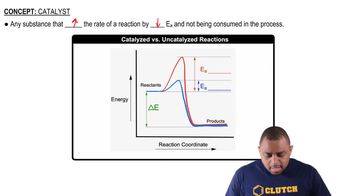
Enzyme catalysis involves the acceleration of a chemical reaction by a catalyst, which in biological systems is typically an enzyme. Enzymes work by providing an alternative reaction pathway with a lower activation energy, thus increasing the reaction rate significantly. The effectiveness of an enzyme can be quantified by how much it reduces the activation energy compared to the uncatalyzed reaction.
Video consigliato:
Percorso guidato
01:59
Catalyzed vs. Uncatalyzed Reactions

Arrhenius Equation

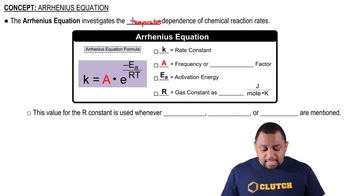
The Arrhenius equation describes the temperature dependence of reaction rates and relates the rate constant of a reaction to its activation energy. It is expressed as k = A * e^(-Ea/RT), where k is the rate constant, A is the frequency factor, Ea is the activation energy, R is the gas constant, and T is the temperature in Kelvin. This equation is crucial for understanding how changes in activation energy affect reaction rates, especially in the context of enzyme activity.
Video consigliato:
Percorso guidato
01:20
Arrhenius Equation