Ch.14 - Chemical Kinetics
Tro - Chemistry: A Molecular Approach 4th Edition
Tro4th EditionChemistry: A Molecular ApproachISBN: 9780134112831Non è quello che usi tu?Cambia libro di testo
Capitolo 14, Problema 57b

The half-life for the radioactive decay of U-238 is 4.5 billion years and is independent of initial concentration. If a sample of U-238 initially contained 1.5⨉1018 atoms when the universe was formed 13.8 billion years ago, how many U-238 atoms does it contain today?

Guida verificata passo dopo passo
1
Identify the given values: the half-life of U-238 is 4.5 billion years, the initial number of atoms is 1.5 \(\times\) 10^{18}, and the time elapsed is 13.8 billion years.
Use the formula for radioactive decay: N(t) = N_0 \(\times\) (1/2)^{t/t_{1/2}}, where N(t) is the number of atoms remaining, N_0 is the initial number of atoms, t is the time elapsed, and t_{1/2} is the half-life.
Substitute the given values into the formula: N(t) = 1.5 \(\times\) 10^{18} \(\times\) (1/2)^{13.8/4.5}.
Calculate the exponent: 13.8/4.5 to determine how many half-lives have passed.
Evaluate the expression to find the remaining number of U-238 atoms, N(t).

Risposta video verificata per un problema simile:

Questa soluzione video è stata consigliata dai nostri tutor come utile per risolvere questo problema.
Durata del video:
5m

Concetti chiave

Ecco i concetti essenziali che devi comprendere per rispondere correttamente alla domanda.

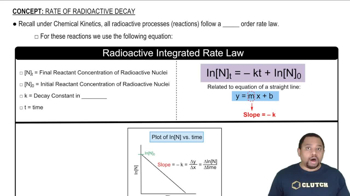
Radioactive Decay

Radioactive decay is the process by which an unstable atomic nucleus loses energy by emitting radiation. This decay occurs at a predictable rate characterized by the half-life, which is the time required for half of the radioactive atoms in a sample to decay. For U-238, this half-life is 4.5 billion years, meaning that after this period, only half of the original amount of U-238 remains.
Video consigliato:
Percorso guidato
03:00
Rate of Radioactive Decay

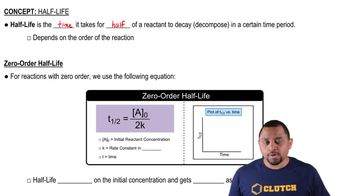
Half-Life

Half-life is a fundamental concept in nuclear chemistry that quantifies the time it takes for half of a radioactive substance to decay. It is a constant for each isotope and does not depend on the initial amount of the substance or environmental conditions. Understanding half-life is crucial for calculating the remaining quantity of a radioactive isotope after a given period, as seen in the decay of U-238 over billions of years.
Video consigliato:
Percorso guidato
02:17
Zero-Order Half-life

Exponential Decay

Exponential decay describes the process where a quantity decreases at a rate proportional to its current value. In the context of radioactive decay, the number of remaining atoms decreases exponentially over time, following the formula N(t) = N0 * (1/2)^(t/T), where N0 is the initial quantity, t is the elapsed time, and T is the half-life. This concept is essential for calculating the remaining U-238 atoms after 13.8 billion years.
Video consigliato: