A reaction has a rate constant of 0.000122/s at 27 °C and 0.228/s at 77 °C. b. What is the value of the rate constant at 17 °C?
Ch.14 - Chemical Kinetics
Tro4th EditionChemistry: A Molecular ApproachISBN: 9780134112831Non è quello che usi tu?Cambia libro di testo
Capitolo 14, Problema 68
The tabulated data show the rate constant of a reaction measured at several different temperatures. Use an Arrhenius plot to determine the activation barrier and frequency factor for the reaction.
Temperature (K) Rate Constant (1 , s)
310 0.00434
320 0.0140
330 0.0421
340 0.118
350 0.316
Guida verificata passo dopo passo1
Convert the temperature from Kelvin to the reciprocal of temperature in Kelvin (1/T) for each data point.
Take the natural logarithm of the rate constant (k) for each temperature.
Plot ln(k) on the y-axis against 1/T on the x-axis to create the Arrhenius plot.
Determine the slope of the line from the plot, which is equal to -Ea/R, where Ea is the activation energy and R is the gas constant (8.314 J/mol·K).
Calculate the activation energy (Ea) using the slope, and determine the frequency factor (A) by finding the y-intercept of the line, which is equal to ln(A).

Risposta video verificata per un problema simile:
Questa soluzione video è stata consigliata dai nostri tutor come utile per risolvere questo problema.
Durata del video:
3mConcetti chiave
Ecco i concetti essenziali che devi comprendere per rispondere correttamente alla domanda.
Arrhenius Equation
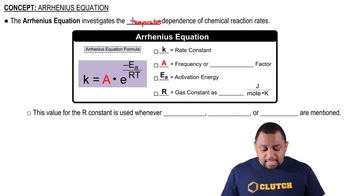
The Arrhenius equation describes how the rate constant of a chemical reaction depends on temperature and activation energy. It is expressed as k = A * e^(-Ea/RT), where k is the rate constant, A is the frequency factor, Ea is the activation energy, R is the universal gas constant, and T is the temperature in Kelvin. This relationship highlights the exponential increase in reaction rates with temperature, making it essential for analyzing reaction kinetics.
Video consigliato:
Percorso guidato
Arrhenius Equation
Activation Energy (Ea)
Activation energy is the minimum energy required for a chemical reaction to occur. It represents the energy barrier that reactants must overcome to transform into products. In an Arrhenius plot, which is a graph of ln(k) versus 1/T, the slope of the line is related to -Ea/R, allowing for the determination of the activation energy from experimental data.
Video consigliato:
Percorso guidato
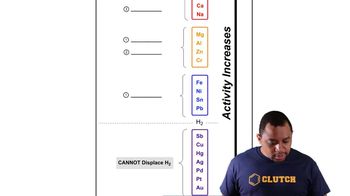
Activity Series Chart
Frequency Factor (A)
The frequency factor, also known as the pre-exponential factor, is a constant in the Arrhenius equation that reflects the frequency of collisions and the orientation of reactants during a reaction. It is indicative of how often reactants collide with the correct orientation to react. The frequency factor can be determined alongside the activation energy when analyzing the slope and intercept of the Arrhenius plot.
Video consigliato:
Percorso guidato
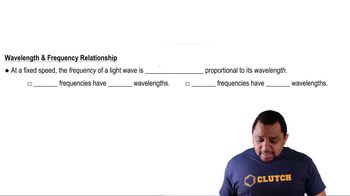
Frequency-Wavelength Relationship
Pratica correlata
Domanda del libro di testo
2142
views
Domanda del libro di testo
A reaction has a rate constant of 0.0117/s at 400.0 K and 0.689/s at 450.0 K. a. Determine the activation barrier for the reaction.
2476
views
8
rank
Domanda del libro di testo
The data shown here were collected for the first-order reaction: N2O(g) → N2(g) + O(g) Use an Arrhenius plot to determine the activation barrier and frequency factor for the reaction.
Temperature (K) Rate Constant (1 , s)
800 3.24⨉10- 5
900 0.00214
1000 0.0614
1100 0.955
1575
views
Domanda del libro di testo
The tabulated data show the rate constant of a reaction measured at several different temperatures. Use an Arrhenius plot to determine the activation barrier and frequency factor for the reaction.
Temperature (K) Rate Constant (1 , s)
300 0.0134
310 0.0407
320 0.114
330 0.303
340 0.757
2534
views