
Ch.14 - Chemical Kinetics
Tro - Chemistry: A Molecular Approach 4th Edition
Tro4th EditionChemistry: A Molecular ApproachISBN: 9780134112831Non è quello che usi tu?Cambia libro di testo
Capitolo 14, Problema 54c

This reaction was monitored as a function of time: AB → A + B A plot of 1/[AB] versus time yields a straight line with a slope of +0.55/Ms. c. What is the half-life when the initial concentration is 0.55 M?

Guida verificata passo dopo passo
1
Identify the order of the reaction. Since a plot of 1/[AB] versus time yields a straight line, the reaction is second order.
Use the second-order half-life formula: \( t_{1/2} = \frac{1}{k[A]_0} \), where \( k \) is the rate constant and \( [A]_0 \) is the initial concentration.
Recognize that the slope of the line in a second-order reaction plot is equal to the rate constant \( k \). Therefore, \( k = 0.55 \text{ M}^{-1}\text{s}^{-1} \).
Substitute the given initial concentration \( [A]_0 = 0.55 \text{ M} \) and the rate constant \( k = 0.55 \text{ M}^{-1}\text{s}^{-1} \) into the half-life formula.
Calculate the half-life using the formula: \( t_{1/2} = \frac{1}{0.55 \times 0.55} \).

Risposta video verificata per un problema simile:

Questa soluzione video è stata consigliata dai nostri tutor come utile per risolvere questo problema.
Durata del video:
1m

Concetti chiave

Ecco i concetti essenziali che devi comprendere per rispondere correttamente alla domanda.

Rate Laws and Reaction Order

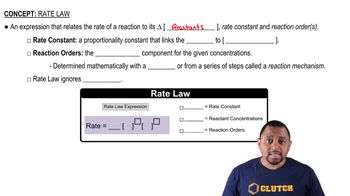
Rate laws describe the relationship between the concentration of reactants and the rate of a chemical reaction. The order of a reaction indicates how the rate is affected by the concentration of each reactant. In this case, the reaction AB → A + B is second-order, as indicated by the linear plot of 1/[AB] versus time, which is characteristic of second-order kinetics.
Video consigliato:
Percorso guidato
01:52
Rate Law Fundamentals

Half-Life of a Reaction

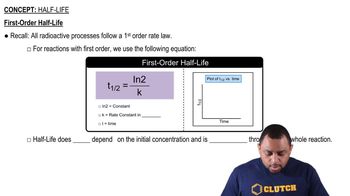
The half-life of a reaction is the time required for the concentration of a reactant to decrease to half of its initial value. For second-order reactions, the half-life is dependent on the initial concentration of the reactant. The formula for the half-life (t1/2) of a second-order reaction is t1/2 = 1/(k[AB]0), where k is the rate constant and [AB]0 is the initial concentration.
Video consigliato:
Percorso guidato
01:49
First-Order Half-Life

Slope of the Rate Plot

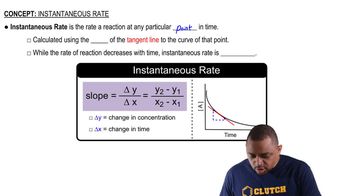
In the context of reaction kinetics, the slope of the plot of 1/[AB] versus time is equal to the rate constant (k) for a second-order reaction. Given that the slope is +0.55/Ms, this value directly represents the rate constant used in calculating the half-life. Understanding how to interpret the slope is crucial for determining the kinetics of the reaction.
Video consigliato:
Percorso guidato
01:30
Instantaneous Rate