
Ch.15 - Chemical Equilibrium
Tro - Chemistry: A Molecular Approach 4th Edition
Tro4th EditionChemistry: A Molecular ApproachISBN: 9780134112831Non è quello che usi tu?Cambia libro di testo
Capitolo 15, Problema 86

A reaction vessel at 27 °C contains a mixture of SO2 (P = 3.00 atm) and O2 (P = 1.00 atm). When a catalyst is added, this reaction takes place: 2 SO2( g) + O2( g) ⇌ 2 SO3( g). At equilibrium, the total pressure is 3.75 atm. Find the value of Kc.

Guida verificata passo dopo passo
1
Convert the initial temperature from Celsius to Kelvin by using the formula T(K) = T(°C) + 273.15. This will be used in later calculations involving the ideal gas law and equilibrium constants.
Calculate the initial moles of SO2 and O2 using the ideal gas law, PV = nRT, where P is the pressure of the gas, V is the volume, R is the gas constant, and T is the temperature in Kelvin.
Set up an ICE table (Initial, Change, Equilibrium) for the reaction 2 SO2(g) + O2(g) ⇌ 2 SO3(g). Use the initial pressures as proxies for initial concentrations, and express changes in terms of x, where x is the change in moles of O2 reacting.
Write the expression for the equilibrium constant Kp in terms of the partial pressures of the gases at equilibrium. Use the relationship between Kp and Kc, which is Kp = Kc(RT)^(Δn), where Δn is the change in moles of gas (products minus reactants).
Solve for Kc using the equilibrium pressures calculated from the ICE table and the relationship between Kp and Kc. Substitute the values of R, T, and Δn to find Kc.

Risposta video verificata per un problema simile:

Questa soluzione video è stata consigliata dai nostri tutor come utile per risolvere questo problema.

Concetti chiave

Ecco i concetti essenziali che devi comprendere per rispondere correttamente alla domanda.

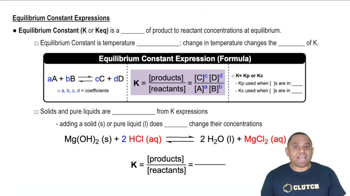
Equilibrium Constant (Kc)

The equilibrium constant (Kc) is a numerical value that expresses the ratio of the concentrations of products to reactants at equilibrium for a given reaction at a specific temperature. It is calculated using the formula Kc = [products]^[coefficients] / [reactants]^[coefficients]. A larger Kc indicates a greater concentration of products at equilibrium, while a smaller Kc suggests a higher concentration of reactants.
Video consigliato:
Percorso guidato
03:20
Equilibrium Constant Expressions

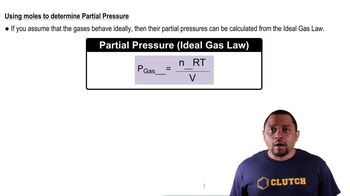
Partial Pressure

Partial pressure is the pressure exerted by a single component of a gas mixture. According to Dalton's Law, the total pressure of a gas mixture is the sum of the partial pressures of each individual gas. In this reaction, the partial pressures of SO2 and O2 before the reaction are crucial for determining the changes in pressure as the reaction proceeds to equilibrium.
Video consigliato:
Percorso guidato
00:48
Partial Pressure Calculation

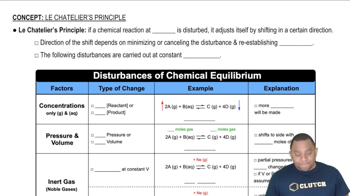
Le Chatelier's Principle

Le Chatelier's Principle states that if a dynamic equilibrium is disturbed by changing the conditions, the system will adjust itself to counteract the change and restore a new equilibrium. In this context, adding a catalyst does not change the position of equilibrium but allows the system to reach equilibrium faster, which is important for calculating Kc based on the final pressures of the gases involved.
Video consigliato:
Percorso guidato
07:32
Le Chatelier's Principle