Ch.15 - Chemical Equilibrium
Tro - Chemistry: A Molecular Approach 4th Edition
Tro4th EditionChemistry: A Molecular ApproachISBN: 9780134112831Non è quello che usi tu?Cambia libro di testo
Capitolo 15, Problema 32b,c

Calculate Kp for each reaction.
b. N2(g) + 3 H2(g) ⇌ 2 NH3(g) Kc = 3.7⨉108 (at 298 K)
c. N2(g) + O2(g) ⇌ 2 NO(g) Kc = 4.10⨉10-31 (at 298 K)

Guida verificata passo dopo passo
1
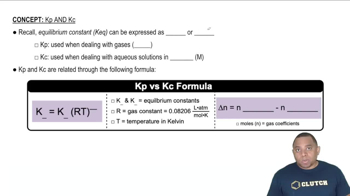
Identify the relationship between Kc and Kp using the equation: Kp = Kc(RT)^(Δn), where Δn is the change in moles of gas, R is the ideal gas constant, and T is the temperature in Kelvin.
Calculate Δn for the reaction: Δn = (moles of gaseous products) - (moles of gaseous reactants). For the reaction N2(g) + 3H2(g) ⇌ 2NH3(g), Δn = 2 - (1 + 3).
Substitute the values into the equation: Kp = Kc(RT)^(Δn). Use R = 0.0821 L·atm/(mol·K) and T = 298 K.
Simplify the expression by calculating (RT)^(Δn) using the values of R, T, and Δn.
Multiply Kc by the result from the previous step to find Kp.

Risposta video verificata per un problema simile:

Questa soluzione video è stata consigliata dai nostri tutor come utile per risolvere questo problema.
Durata del video:
2m

Concetti chiave

Ecco i concetti essenziali che devi comprendere per rispondere correttamente alla domanda.

Equilibrium Constant (Kc and Kp)

The equilibrium constant (K) quantifies the ratio of the concentrations of products to reactants at equilibrium for a given reaction. Kc refers to concentrations in molarity, while Kp refers to partial pressures. The relationship between Kc and Kp is given by the equation Kp = Kc(RT)^(Δn), where Δn is the change in moles of gas, R is the ideal gas constant, and T is the temperature in Kelvin.
Video consigliato:
Percorso guidato
02:06
Kp vs. Kc Formula

Reaction Stoichiometry

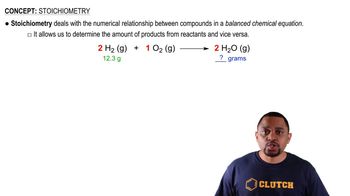
Reaction stoichiometry involves the quantitative relationships between reactants and products in a chemical reaction. In the given reaction, N2(g) + 3H2(g) ⇌ 2NH3(g), the stoichiometric coefficients indicate that one mole of nitrogen reacts with three moles of hydrogen to produce two moles of ammonia. This stoichiometry is crucial for calculating changes in concentrations or pressures at equilibrium.
Video consigliato:
Percorso guidato
01:16
Stoichiometry Concept

Temperature Dependence of Kp

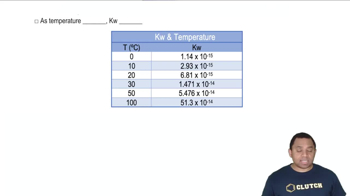
The equilibrium constant Kp is temperature-dependent, meaning its value changes with temperature. For exothermic reactions, Kp decreases with increasing temperature, while for endothermic reactions, Kp increases. Understanding this dependence is essential when calculating Kp at a specific temperature, as it directly influences the equilibrium position and the concentrations of reactants and products.
Video consigliato:
Percorso guidato
01:24
Kw Temperature Dependence