

Ch.15 - Chemical Equilibrium
Tro - Chemistry: A Molecular Approach 4th Edition
Tro4th EditionChemistry: A Molecular ApproachISBN: 9780134112831Non è quello che usi tu?Cambia libro di testo
Capitolo 15, Problema 73

Carbon monoxide replaces oxygen in oxygenated hemoglobin according to the reaction: HbO2(aq) + CO(aq) ⇌ HbCO(aq) + O2(aq) a. Use the reactions and associated equilibrium constants at body temperature given here to find the equilibrium constant for the reaction just shown. Hb(aq) + O2(aq) ⇌ HbO2(aq) Kc = 1.8 Hb(aq) + CO(aq) ⇌ HbCO(aq) Kc = 306

Guida verificata passo dopo passo
1
Identify the given reactions and their equilibrium constants: Reaction 1: Hb(aq) + O_2(aq) \(\rightleftharpoons\) HbO_2(aq) with K_{c1} = 1.8; Reaction 2: Hb(aq) + CO(aq) \(\rightleftharpoons\) HbCO(aq) with K_{c2} = 306.
Write the target reaction: HbO_2(aq) + CO(aq) \(\rightleftharpoons\) HbCO(aq) + O_2(aq).
Express the target reaction in terms of the given reactions: Reverse Reaction 1 to get HbO_2(aq) \(\rightleftharpoons\) Hb(aq) + O_2(aq) with K_{c1}' = \(\frac{1}{1.8}\).
Combine the reversed Reaction 1 with Reaction 2: HbO_2(aq) + CO(aq) \(\rightleftharpoons\) Hb(aq) + O_2(aq) + Hb(aq) + CO(aq) \(\rightleftharpoons\) HbCO(aq) + O_2(aq).
Calculate the equilibrium constant for the target reaction by multiplying the equilibrium constants of the combined reactions: K_{c} = K_{c1}' \(\times\) K_{c2}.

Risposta video verificata per un problema simile:

Questa soluzione video è stata consigliata dai nostri tutor come utile per risolvere questo problema.
Durata del video:
1m

Concetti chiave

Ecco i concetti essenziali che devi comprendere per rispondere correttamente alla domanda.

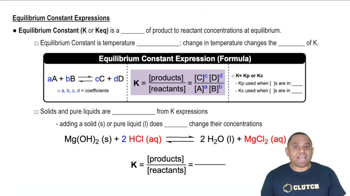
Equilibrium Constant (Kc)

The equilibrium constant (Kc) is a numerical value that expresses the ratio of the concentrations of products to reactants at equilibrium for a given chemical reaction. It provides insight into the extent to which a reaction proceeds before reaching equilibrium. A larger Kc indicates a greater concentration of products compared to reactants, while a smaller Kc suggests the opposite.
Video consigliato:
Percorso guidato
03:20
Equilibrium Constant Expressions

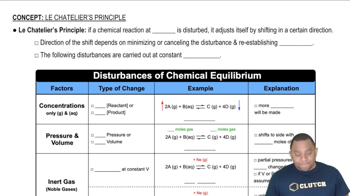
Le Chatelier's Principle

Le Chatelier's Principle states that if a dynamic equilibrium is disturbed by changing the conditions, the system will adjust itself to counteract the change and restore a new equilibrium. This principle is crucial for understanding how changes in concentration, pressure, or temperature affect the position of equilibrium in a chemical reaction.
Video consigliato:
Percorso guidato
07:32
Le Chatelier's Principle

Reaction Stoichiometry

Reaction stoichiometry involves the quantitative relationships between the reactants and products in a chemical reaction, as described by the balanced chemical equation. It is essential for calculating the equilibrium constant and understanding how changes in the concentration of one species affect the others in the reaction, particularly in complex equilibria involving multiple reactions.
Video consigliato:
Percorso guidato
01:16
Stoichiometry Concept