
Ch.15 - Chemical Equilibrium
Tro - Chemistry: A Molecular Approach 4th Edition
Tro4th EditionChemistry: A Molecular ApproachISBN: 9780134112831Non è quello che usi tu?Cambia libro di testo
Capitolo 15, Problema 48

Consider the reaction: 2H2S(g) ⇌ 2H2(g) + S2(g). Kp = 2.4 * 10^-4 at 1073K. A reaction mixture contains 0.112 atm of H2, 0.055 atm of S2, and 0.445 atm of H2S. Is the reaction mixture at equilibrium? If not, in what direction will the reaction proceed?

Guida verificata passo dopo passo
1
Calculate the reaction quotient, Qp, using the expression for the equilibrium constant Kp: \( Q_p = \frac{(P_{H_2})^2 \cdot (P_{S_2})}{(P_{H_2S})^2} \).
Substitute the given partial pressures into the expression: \( Q_p = \frac{(0.112)^2 \cdot (0.055)}{(0.445)^2} \).
Compare the calculated Qp with the given Kp (2.4 \(\times\) 10^{-4}).
If \( Q_p = K_p \), the system is at equilibrium. If \( Q_p < K_p \), the reaction will proceed in the forward direction to reach equilibrium. If \( Q_p > K_p \), the reaction will proceed in the reverse direction to reach equilibrium.
Determine the direction of the reaction based on the comparison of Qp and Kp.

Concetti chiave

Ecco i concetti essenziali che devi comprendere per rispondere correttamente alla domanda.

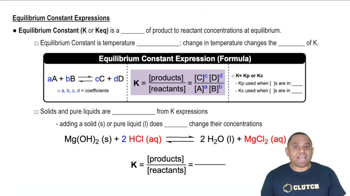
Equilibrium Constant (Kp)

The equilibrium constant (Kp) is a numerical value that expresses the ratio of the concentrations of products to reactants at equilibrium for a given reaction at a specific temperature. For the reaction 2H2S(g) ⇌ 2H2(g) + S2(g), Kp is calculated using the partial pressures of the gases involved. A Kp value less than 1 indicates that at equilibrium, the reactants are favored over the products.
Video consigliato:
Percorso guidato
03:20
Equilibrium Constant Expressions

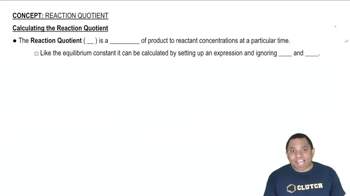
Reaction Quotient (Qp)

The reaction quotient (Qp) is calculated using the same formula as Kp but uses the current concentrations or partial pressures of the reactants and products in the system. By comparing Qp to Kp, one can determine whether the reaction is at equilibrium (Qp = Kp), or if it will shift towards the products (Qp < Kp) or reactants (Qp > Kp) to reach equilibrium.
Video consigliato:
Percorso guidato
00:49
Reaction Quotient Q

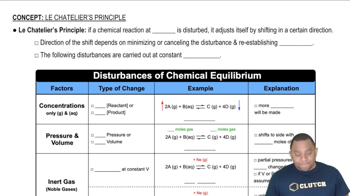
Le Chatelier's Principle

Le Chatelier's Principle states that if a dynamic equilibrium is disturbed by changing the conditions, the system will adjust itself to counteract the change and restore a new equilibrium. This principle helps predict the direction in which a reaction will shift when the concentrations of reactants or products are altered, or when temperature or pressure changes occur.
Video consigliato:
Percorso guidato
07:32
Le Chatelier's Principle