
Ch.15 - Chemical Equilibrium
Tro - Chemistry: A Molecular Approach 4th Edition
Tro4th EditionChemistry: A Molecular ApproachISBN: 9780134112831Non è quello che usi tu?Cambia libro di testo
Capitolo 15, Problema 36

Consider the reaction: NH4HS(s) ⇌ NH3(g) + H2S(g). An equilibrium mixture of this reaction at a certain temperature has [NH3] = 0.278 M and [H2S] = 0.355 M. What is the value of the equilibrium constant (Kc) at this temperature?

Guida verificata passo dopo passo
1
Identify the balanced chemical equation: NH4HS(s) ⇌ NH3(g) + H2S(g).
Recognize that the equilibrium constant expression (Kc) for this reaction involves only the gaseous products, since solids are not included in the expression.
Write the expression for the equilibrium constant: Kc = [NH3][H2S].
Substitute the given equilibrium concentrations into the Kc expression: Kc = (0.278)(0.355).
Calculate the product of the concentrations to find the value of Kc.

Concetti chiave

Ecco i concetti essenziali che devi comprendere per rispondere correttamente alla domanda.

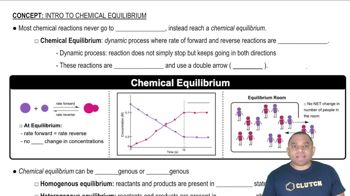
Chemical Equilibrium

Chemical equilibrium occurs when the rates of the forward and reverse reactions are equal, resulting in constant concentrations of reactants and products. In this state, the system is dynamic, meaning that reactions continue to occur, but there is no net change in the concentrations of the substances involved.
Video consigliato:
Percorso guidato
04:21
Chemical Equilibrium Concepts

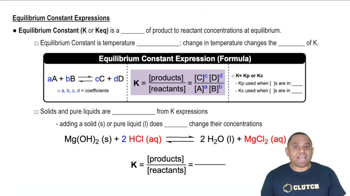
Equilibrium Constant (Kc)

The equilibrium constant (Kc) is a numerical value that expresses the ratio of the concentrations of products to reactants at equilibrium, each raised to the power of their coefficients in the balanced equation. For the reaction NH4HS(s) ⇌ NH3(g) + H2S(g), Kc is calculated using the formula Kc = [NH3][H2S], as solids do not appear in the expression.
Video consigliato:
Percorso guidato
03:20
Equilibrium Constant Expressions

Concentration Units

Concentration is a measure of the amount of a substance in a given volume of solution, typically expressed in molarity (M), which is moles of solute per liter of solution. Understanding how to interpret and manipulate concentration values is essential for calculating equilibrium constants and analyzing chemical reactions.
Video consigliato: