

Ch.15 - Chemical Equilibrium
Tro - Chemistry: A Molecular Approach 4th Edition
Tro4th EditionChemistry: A Molecular ApproachISBN: 9780134112831Non è quello che usi tu?Cambia libro di testo
Capitolo 15, Problema 64b

Consider this reaction at equilibrium: 2 BrNO(g) ⇌ 2 NO(g) + Br2(g) Predict whether the reaction will shift left, shift right, or remain unchanged after each disturbance. b. BrNO is added to the reaction mixture.

Guida verificata passo dopo passo
1
Identify the reaction and the change: The reaction given is 2 BrNO(g) ⇌ 2 NO(g) + Br2(g). The disturbance is the addition of BrNO to the reaction mixture.
Apply Le Chatelier's Principle: According to Le Chatelier's Principle, if a system at equilibrium is disturbed by changing the conditions, the system responds in a way that tends to counteract the change and restore a new equilibrium.
Analyze the effect of adding BrNO: Adding more BrNO increases the concentration of BrNO in the reaction mixture.
Predict the shift in equilibrium: With an increase in the concentration of BrNO, the system will try to decrease this concentration to restore equilibrium. This can be achieved by converting some of the added BrNO into NO and Br2.
Conclusion: The reaction will shift to the right, towards the production of more NO and Br2, in response to the addition of BrNO.

Risposta video verificata per un problema simile:

Questa soluzione video è stata consigliata dai nostri tutor come utile per risolvere questo problema.
Durata del video:
1m

Concetti chiave

Ecco i concetti essenziali che devi comprendere per rispondere correttamente alla domanda.

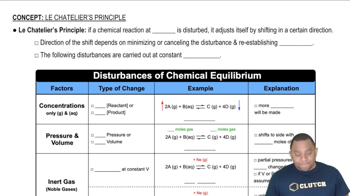
Le Chatelier's Principle

Le Chatelier's Principle states that if a dynamic equilibrium is disturbed by changing the conditions, the position of equilibrium shifts to counteract the change. This means that if a reactant or product is added or removed, the system will adjust to restore equilibrium, either by favoring the forward or reverse reaction.
Video consigliato:
Percorso guidato
07:32
Le Chatelier's Principle

Equilibrium Constant (K)

The equilibrium constant (K) is a numerical value that expresses the ratio of the concentrations of products to reactants at equilibrium for a given reaction at a specific temperature. It provides insight into the extent of the reaction and helps predict the direction of the shift when the system is disturbed.
Video consigliato:
Percorso guidato
01:14
Equilibrium Constant K

Concentration Changes

Changes in concentration of reactants or products can significantly affect the position of equilibrium. When the concentration of a reactant, such as BrNO, is increased, the system will respond by shifting the equilibrium to the right, favoring the formation of products (NO and Br2) to reduce the disturbance.
Video consigliato:
Percorso guidato
01:53
Chemical Changes