
Ch.15 - Chemical Equilibrium
Tro - Chemistry: A Molecular Approach 4th Edition
Tro4th EditionChemistry: A Molecular ApproachISBN: 9780134112831Non è quello che usi tu?Cambia libro di testo
Capitolo 15, Problema 67

Each reaction is allowed to come to equilibrium, and then the volume is changed as indicated. Predict the effect (shift right, shift left, or no effect) of the indicated volume change. a. I2( g) ⇌ 2 I( g) (volume is increased) b. 2 H2S( g) ⇌ 2 H2( g) + S2(g) (volume is decreased) c. I2(g) + Cl2(g) ⇌ 2 ICl(g) (volume is decreased)

Guida verificata passo dopo passo
1
Identify the reaction and the change in conditions: The reaction given is 2 H2S(g) ⇌ 2 H2(g) + S2(g), and the volume of the container is decreased.
Recall Le Chatelier's Principle, which states that if a system at equilibrium is subjected to a change, the system will adjust itself to partially oppose the effect of the change.
Determine the change in pressure due to the volume decrease. Decreasing the volume of a gas increases the pressure of the system.
Analyze the stoichiometry of the reaction: The reaction starts with 2 moles of H2S and produces a total of 3 moles of gas (2 moles of H2 and 1 mole of S2).
Predict the shift in equilibrium: Since decreasing the volume increases the pressure, the equilibrium will shift towards the side with fewer moles of gas to reduce the pressure. In this case, the equilibrium will shift to the left, favoring the formation of H2S.

Risposta video verificata per un problema simile:

Questa soluzione video è stata consigliata dai nostri tutor come utile per risolvere questo problema.
Durata del video:
2m

Concetti chiave

Ecco i concetti essenziali che devi comprendere per rispondere correttamente alla domanda.

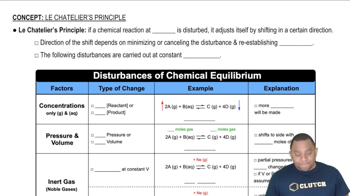
Le Chatelier's Principle

Le Chatelier's Principle states that if a dynamic equilibrium is disturbed by changing the conditions, the system will respond by shifting in a direction that counteracts the change. This principle helps predict how a system at equilibrium will react to changes in concentration, temperature, or pressure.
Video consigliato:
Percorso guidato
07:32
Le Chatelier's Principle

Effect of Volume Change on Gaseous Equilibria

In gaseous equilibria, a decrease in volume increases the pressure of the system. According to Le Chatelier's Principle, the equilibrium will shift toward the side with fewer moles of gas to reduce the pressure. Conversely, an increase in volume would shift the equilibrium toward the side with more moles of gas.
Video consigliato:
Percorso guidato
02:35
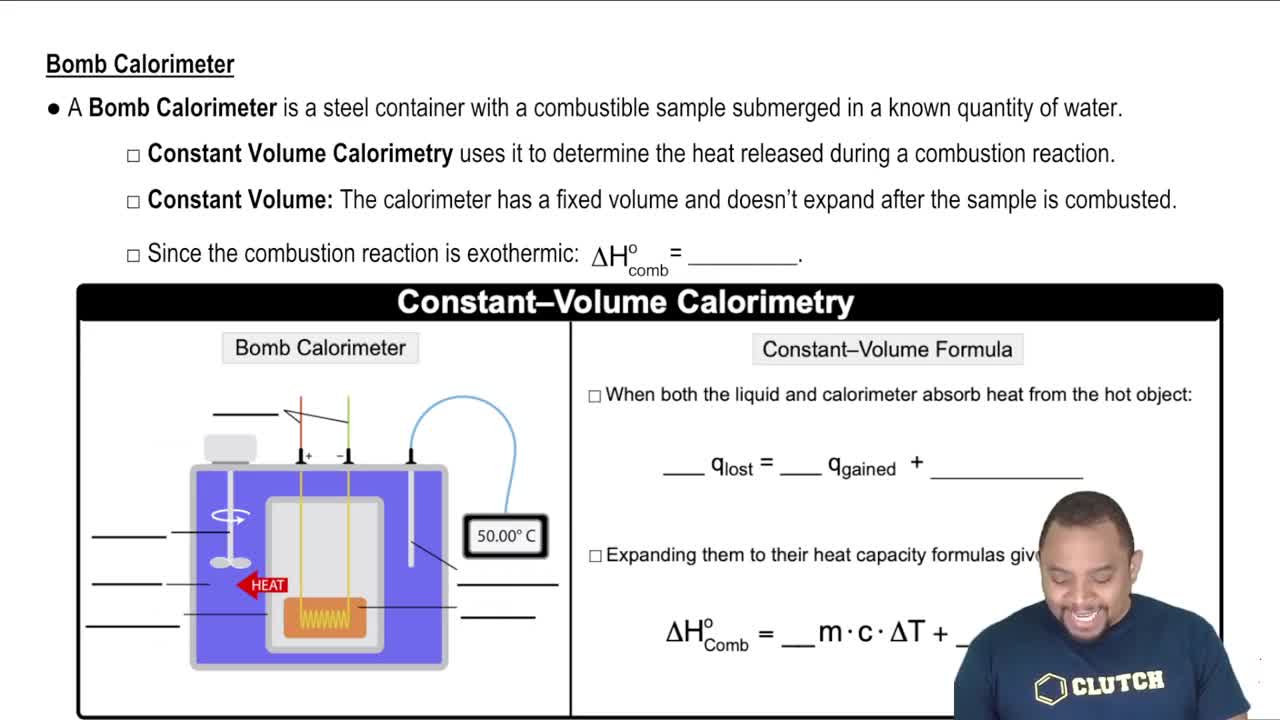
Constant-Volume Calorimetry

Stoichiometry of the Reaction

The stoichiometry of a chemical reaction provides the ratio of reactants to products. In the reaction 2 H2S(g) ⇌ 2 H2(g) + S2(g), there are 2 moles of H2S on the reactant side and 3 moles of gas (2 moles of H2 and 1 mole of S2) on the product side. Understanding this ratio is crucial for predicting the direction of the shift when volume changes.
Video consigliato:
Percorso guidato
01:16
Stoichiometry Concept
Pratica correlata
Domanda del libro di testo

Consider this reaction at equilibrium: C(s) + H2O(g) ⇌ CO(g) + H2(g) Predict whether the reaction will shift left, shift right, or remain unchanged after each disturbance. a. C is added to the reaction mixture. b. H2O is condensed and removed from the reaction mixture. Predict whether the reaction will shift left, shift right, or remain unchanged after each disturbance. c. CO is added to the reaction mixture. d. H2 is removed from the reaction mixture.

5795
views
Domanda del libro di testo

Each reaction is allowed to come to equilibrium, and then the volume is changed as indicated. Predict the effect (shift right, shift left, or no effect) of the indicated volume change. a. CO(g) + H2O( g) ⇌ CO2(g) + H2(g) (volume is decreased)

456
views
Domanda del libro di testo

Consider this reaction at equilibrium: 2 BrNO(g) ⇌ 2 NO(g) + Br2(g) Predict whether the reaction will shift left, shift right, or remain unchanged after each disturbance. c. Br2 is removed from the reaction mixture.

1924
views
Domanda del libro di testo

Each reaction is allowed to come to equilibrium, and then the volume is changed as indicated. Predict the effect (shift right, shift left, or no effect) of the indicated volume change. b. PCl3(g) + Cl2(g) ⇌ PCl5(g) (volume is increased)

373
views
Domanda del libro di testo

Each reaction is allowed to come to equilibrium, and then the volume is changed as indicated. Predict the effect (shift right, shift left, or no effect) of the indicated volume change. c. CaCO3(s) ⇌ CaO(s) + CO2(g) (volume is increased)

657
views