
Ch.15 - Chemical Equilibrium
Tro - Chemistry: A Molecular Approach 4th Edition
Tro4th EditionChemistry: A Molecular ApproachISBN: 9780134112831Non è quello che usi tu?Cambia libro di testo
Capitolo 15, Problema 54

For the reaction shown here, Kc = 255 at 1000 K. CO(g) + Cl2(g) ⇌ COCl2(g) If a reaction mixture initially contains a CO concentration of 0.1500 M and a Cl2 concentration of 0.175 M at 1000 K, what are the equilibrium concentrations of CO, Cl2, and COCl2 at 1000 K?

Guida verificata passo dopo passo
1
Step 1: Set up the initial concentrations of the reactants and products. For CO and Cl2, the initial concentrations are given as 0.1500 M and 0.175 M, respectively. Assume the initial concentration of COCl2 is 0 M.
Step 2: Define the change in concentration that occurs as the system reaches equilibrium. Let x be the amount of CO and Cl2 that reacts. At equilibrium, the concentration of CO and Cl2 will decrease by x, and the concentration of COCl2 will increase by x.
Step 3: Write the equilibrium expression for the reaction using the equilibrium constant Kc. The expression is Kc = \(\frac{[COCl2]}{[CO][Cl2]}\).
Step 4: Substitute the equilibrium concentrations into the Kc expression. This gives Kc = \(\frac{x}{(0.1500 - x)(0.175 - x)}\).
Step 5: Solve the equation for x using algebraic methods or a numerical solver to find the equilibrium concentrations of CO, Cl2, and COCl2.

Risposta video verificata per un problema simile:

Questa soluzione video è stata consigliata dai nostri tutor come utile per risolvere questo problema.

Concetti chiave

Ecco i concetti essenziali che devi comprendere per rispondere correttamente alla domanda.

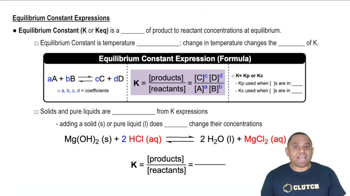
Equilibrium Constant (Kc)

The equilibrium constant, Kc, is a numerical value that expresses the ratio of the concentrations of products to reactants at equilibrium for a given reaction at a specific temperature. For the reaction CO(g) + Cl2(g) ⇌ COCl2(g), Kc = [COCl2] / ([CO][Cl2]). A higher Kc value indicates a greater concentration of products at equilibrium.
Video consigliato:
Percorso guidato
03:20
Equilibrium Constant Expressions

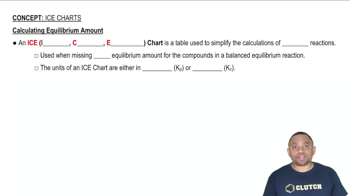
ICE Table (Initial, Change, Equilibrium)

An ICE table is a tool used to organize the initial concentrations, the changes in concentrations as the reaction proceeds, and the equilibrium concentrations of reactants and products. By setting up an ICE table for the given reaction, one can systematically determine how the concentrations of CO, Cl2, and COCl2 change until equilibrium is reached.
Video consigliato:
Percorso guidato
01:14
ICE Charts and Equilibrium Amount

Le Chatelier's Principle

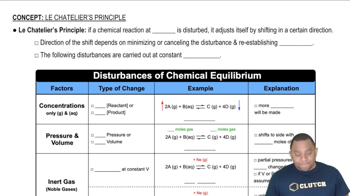
Le Chatelier's Principle states that if a dynamic equilibrium is disturbed by changing the conditions, the system will adjust to counteract the change and restore a new equilibrium. This principle helps predict how changes in concentration, pressure, or temperature will affect the position of equilibrium in the reaction CO(g) + Cl2(g) ⇌ COCl2(g).
Video consigliato:
Percorso guidato
07:32
Le Chatelier's Principle