Ch.15 - Chemical Equilibrium
Tro - Chemistry: A Molecular Approach 4th Edition
Tro4th EditionChemistry: A Molecular ApproachISBN: 9780134112831Non è quello che usi tu?Cambia libro di testo
Capitolo 15, Problema 23

When this reaction comes to equilibrium, will the concentrations of the reactants or products be greater? Does the answer to this question depend on the initial concentrations of the reactants and products? A(g)+B(g) ⇌ 2 C(g) Kc = 1.4⨉10-5

Guida verificata passo dopo passo
1
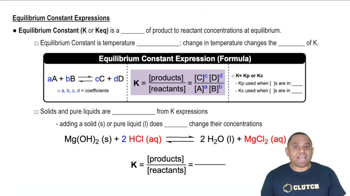
Identify the equilibrium constant expression for the reaction: \( K_c = \frac{[C]^2}{[A][B]} \).
Recognize that the equilibrium constant \( K_c \) is very small (\( 1.4 \times 10^{-5} \)), indicating that the reaction favors the reactants.
Understand that a small \( K_c \) value means that at equilibrium, the concentration of products \([C]\) will be much smaller compared to the concentrations of reactants \([A]\) and \([B]\).
Conclude that the concentrations of the reactants \([A]\) and \([B]\) will be greater than the concentration of the product \([C]\) at equilibrium.
Note that the answer does not depend on the initial concentrations of the reactants and products, as \( K_c \) is a constant at a given temperature.

Risposta video verificata per un problema simile:

Questa soluzione video è stata consigliata dai nostri tutor come utile per risolvere questo problema.
Durata del video:
1m

Concetti chiave

Ecco i concetti essenziali che devi comprendere per rispondere correttamente alla domanda.

Chemical Equilibrium

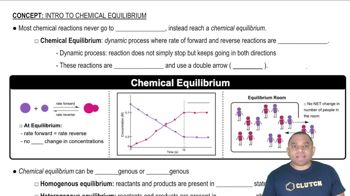
Chemical equilibrium occurs when the rates of the forward and reverse reactions are equal, resulting in constant concentrations of reactants and products. At this point, the system is dynamic, meaning that reactions continue to occur, but there is no net change in concentration. Understanding this concept is crucial for analyzing how concentrations shift in response to changes in conditions.
Video consigliato:
Percorso guidato
04:21
Chemical Equilibrium Concepts

Equilibrium Constant (Kc)

The equilibrium constant (Kc) quantifies the ratio of the concentrations of products to reactants at equilibrium for a given reaction at a specific temperature. A small Kc value, such as 1.4x10^-5, indicates that at equilibrium, the concentration of reactants is much greater than that of products. This value helps predict the direction of the reaction and the relative amounts of substances present at equilibrium.
Video consigliato:
Percorso guidato
03:20
Equilibrium Constant Expressions

Le Chatelier's Principle

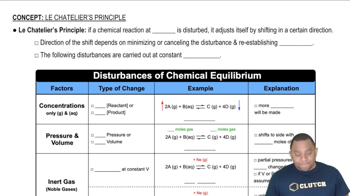
Le Chatelier's Principle states that if a system at equilibrium is subjected to a change in concentration, temperature, or pressure, the system will adjust to counteract that change and restore a new equilibrium. This principle is essential for understanding how initial concentrations of reactants and products can influence the final equilibrium concentrations, as shifts in equilibrium can occur based on these initial conditions.
Video consigliato:
Percorso guidato
07:32
Le Chatelier's Principle
Pratica correlata
Domanda del libro di testo

Find and fix each mistake in the equilibrium constant expressions. a. 2 H2S(g) ⇌ 2 H2(g) + S2(g) K = [H2][S2]/[H2S]

520
views

Domanda del libro di testo

Write an expression for the equilibrium constant of each chemical equation.

a. SbCl5(g) ⇌ SbCl3(g) + Cl2(g)

b.2 BrNO(g) ⇌ 2 NO(g) + Br2(g)

c. CH4(g) + 2 H2S(g) ⇌ CS2(g) + 4 H2(g)

d. 2 CO(g) + O2(g) ⇌ 2 CO2(g)

961
views
Domanda del libro di testo

Find and fix each mistake in the equilibrium constant expressions. b. CO(g) + Cl2(g) ⇌ COCl2(g) K = [CO][Cl2]/[COCl2]

442
views
Domanda del libro di testo

H2 and I2 are combined in a flask and allowed to react according to the reaction: H2(g) + I2(g) ⇌ 2 HI(g) Examine the figures (sequential in time) and answer the questions: a. Which figure represents the point at which equilibrium is reached?

824
views
Domanda del libro di testo

Ethene (C2H4) can be halogenated by this reaction: C2H4(g) + X2(g) ⇌ C2H4X2(g) where X2 can be Cl2 (green), Br2 (brown), or I2 (purple). Examine the three figures representing equilibrium concentrations in this reaction at the same temperature for the three different hal- ogens. Rank the equilibrium constants for the three reactions from largest to smallest.

1448
views
1
rank
Domanda del libro di testo

A chemist trying to synthesize a particular compound attempts two different synthesis reactions. The equilibrium constants for the two reactions are 23.3 and 2.2⨉104 at room temperature. However, upon carrying out both reactions for 15 minutes, the chemist finds that the reaction with the smaller equilibrium constant produces more of the desired product. Explain how this might be possible.

1175
views