Ch.16 - Acids and Bases
Tro - Chemistry: A Molecular Approach 4th Edition
Tro4th EditionChemistry: A Molecular ApproachISBN: 9780134112831Non è quello che usi tu?Cambia libro di testo
Capitolo 16, Problema 120

Based on molecular structure, arrange the oxyacids in order of increasing acid strength. Explain your choice. HClO3, HIO3, HBrO3

Guida verificata passo dopo passo
1
insert step 1> Identify the general structure of the oxyacids in question. Each of these acids has the form HXO3, where X is a halogen (Cl, Br, I).
insert step 2> Understand that the acid strength of oxyacids generally increases with the electronegativity of the central atom (X). This is because a more electronegative central atom can better stabilize the negative charge on the conjugate base after the acid donates a proton.
insert step 3> Compare the electronegativities of the halogens: Chlorine (Cl) is more electronegative than Bromine (Br), which is more electronegative than Iodine (I).
insert step 4> Based on the electronegativity trend, predict the order of acid strength: HClO3 should be the strongest acid, followed by HBrO3, and then HIO3 as the weakest.
insert step 5> Conclude that the order of increasing acid strength is: HIO3 < HBrO3 < HClO3.

Risposta video verificata per un problema simile:

Questa soluzione video è stata consigliata dai nostri tutor come utile per risolvere questo problema.
Durata del video:
2m

Concetti chiave

Ecco i concetti essenziali che devi comprendere per rispondere correttamente alla domanda.

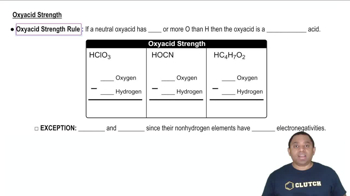
Oxyacid Strength

The strength of oxyacids is influenced by the number of oxygen atoms bonded to the central atom and the electronegativity of that central atom. Generally, more oxygen atoms increase the acid's strength due to greater resonance stabilization of the conjugate base. Additionally, higher electronegativity of the central atom leads to stronger acids as it stabilizes the negative charge on the conjugate base.
Video consigliato:
Percorso guidato
02:21
Oxyacid Strength Rule

Resonance Stabilization

Resonance stabilization occurs when a molecule can be represented by multiple valid Lewis structures, allowing for the delocalization of electrons. In oxyacids, the conjugate base can often be stabilized through resonance, which lowers the energy of the species and increases the acid's strength. The more resonance structures available, the more stable the conjugate base, leading to a stronger acid.
Video consigliato:
Percorso guidato
01:42
Resonance Structures

Electronegativity Trends

Electronegativity is the tendency of an atom to attract electrons in a bond. In the context of oxyacids, the central atom's electronegativity affects the acid's strength. For example, as you move from iodine (I) to bromine (Br) to chlorine (Cl) in the periodic table, the electronegativity increases, which typically results in stronger acids due to better stabilization of the conjugate base.
Video consigliato:
Percorso guidato
02:10
Electronegativity Trends