Ch.16 - Acids and Bases
Tro - Chemistry: A Molecular Approach 4th Edition
Tro4th EditionChemistry: A Molecular ApproachISBN: 9780134112831Non è quello che usi tu?Cambia libro di testo
Capitolo 16, Problema 124d

Classify each species as either a Lewis acid or a Lewis base. d. CN–

Guida verificata passo dopo passo
1
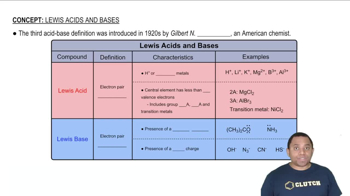
Understand the definition of a Lewis acid and a Lewis base: A Lewis acid is a species that can accept an electron pair, while a Lewis base is a species that can donate an electron pair.
Examine the chemical species CN⁻: The cyanide ion (CN⁻) has a negative charge, indicating it has an extra electron pair.
Consider the electron configuration of CN⁻: The negative charge suggests that CN⁻ has a lone pair of electrons that it can donate.
Determine the role of CN⁻: Since CN⁻ can donate an electron pair, it acts as a Lewis base.
Conclude the classification: CN⁻ is classified as a Lewis base because it donates an electron pair.

Risposta video verificata per un problema simile:

Questa soluzione video è stata consigliata dai nostri tutor come utile per risolvere questo problema.
Durata del video:
2m

Concetti chiave

Ecco i concetti essenziali che devi comprendere per rispondere correttamente alla domanda.

Lewis Acids and Bases

Lewis acids are defined as electron pair acceptors, while Lewis bases are electron pair donors. This classification is based on the ability of a species to either accept or donate a pair of electrons during a chemical reaction, expanding the traditional definitions of acids and bases beyond just protons.
Video consigliato:
Percorso guidato
05:04
Lewis Acids and Bases

Electron Pair Donation

A Lewis base donates an electron pair to form a covalent bond with a Lewis acid. This process is crucial in many chemical reactions, as it allows for the formation of new compounds and the stabilization of reactive intermediates. Understanding which species can donate electron pairs is essential for classifying them correctly.
Video consigliato:
Percorso guidato
00:47
Valence Shell Electron Pair Repulsion Theory

Cyanide Ion (CN-)

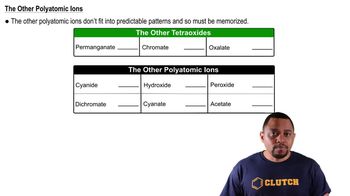
The cyanide ion (CN-) is a well-known example of a Lewis base because it has a lone pair of electrons on the carbon atom that can be donated to a Lewis acid. This property allows CN- to participate in various chemical reactions, including coordination complexes and nucleophilic substitutions.
Video consigliato:
Percorso guidato
02:31
Other Polyatomic Ions