Ch.16 - Acids and Bases
Tro - Chemistry: A Molecular Approach 4th Edition
Tro4th EditionChemistry: A Molecular ApproachISBN: 9780134112831Non è quello che usi tu?Cambia libro di testo
Capitolo 16, Problema 67

If 15.0 mL of glacial acetic acid (pure HC2H3O2) is diluted to 1.50 L with water, what is the pH of the resulting solution? The density of glacial acetic acid is 1.05 g/mL.

Guida verificata passo dopo passo
1
Calculate the mass of glacial acetic acid using its volume and density: \( \text{mass} = \text{volume} \times \text{density} \).
Convert the mass of acetic acid to moles using its molar mass: \( \text{moles} = \frac{\text{mass}}{\text{molar mass}} \).
Determine the concentration of acetic acid in the diluted solution by dividing the moles of acetic acid by the total volume of the solution in liters.
Use the expression for the acid dissociation constant \( K_a \) of acetic acid to set up an equation: \( K_a = \frac{[H^+][A^-]}{[HA]} \), where \([HA]\) is the concentration of acetic acid, and \([H^+]\) and \([A^-]\) are the concentrations of hydrogen ions and acetate ions, respectively.
Solve for \([H^+]\) and then calculate the pH using the formula \( \text{pH} = -\log[H^+] \).

Concetti chiave

Ecco i concetti essenziali che devi comprendere per rispondere correttamente alla domanda.

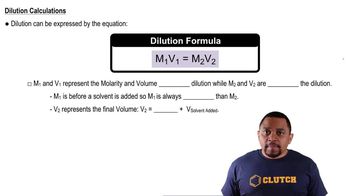
Dilution and Concentration

Dilution refers to the process of reducing the concentration of a solute in a solution, typically by adding more solvent. In this case, glacial acetic acid is diluted from a small volume (15.0 mL) to a larger volume (1.50 L). The concentration of the acetic acid can be calculated using the formula C1V1 = C2V2, where C is concentration and V is volume.
Video consigliato:
Percorso guidato
00:58
Dilution Equation

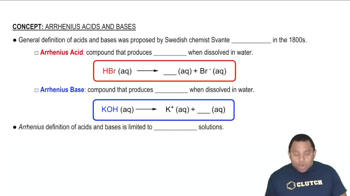
Acid-Base Chemistry

Acetic acid (HC2H3O2) is a weak acid that partially dissociates in water to produce hydrogen ions (H+) and acetate ions (C2H3O2-). The pH of a solution is a measure of its acidity, calculated as pH = -log[H+]. Understanding the dissociation of weak acids is crucial for determining the pH of the resulting solution after dilution.
Video consigliato:
Percorso guidato
02:00
Arrhenius Acids and Bases

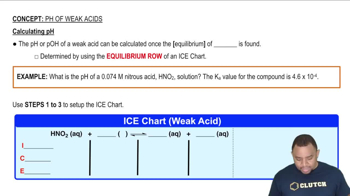
pH Calculation for Weak Acids

To calculate the pH of a weak acid solution, one must first determine the concentration of hydrogen ions produced from the acid's dissociation. For acetic acid, the dissociation constant (Ka) is used to find the equilibrium concentrations of H+ and the undissociated acid. The pH can then be calculated from the concentration of H+ ions, which is essential for understanding the solution's acidity.
Video consigliato:
Percorso guidato
07:51
Calculating pH of Weak Acids Example