Ch.16 - Acids and Bases
Tro - Chemistry: A Molecular Approach 4th Edition
Tro4th EditionChemistry: A Molecular ApproachISBN: 9780134112831Non è quello che usi tu?Cambia libro di testo
Capitolo 16, Problema 36c

In each reaction, identify the Brønsted–Lowry acid, the Brønsted–Lowry base, the conjugate acid, and the conjugate base. c. CO32–(aq) + H2O(l) ⇌ HCO3–(aq) + OH–(aq)

Guida verificata passo dopo passo
1
Identify the species that donates a proton (H⁺) in the reaction. This species is the Brønsted–Lowry acid.
Identify the species that accepts a proton (H⁺) in the reaction. This species is the Brønsted–Lowry base.
Determine the conjugate acid, which is the species formed when the Brønsted–Lowry base gains a proton.
Determine the conjugate base, which is the species formed when the Brønsted–Lowry acid loses a proton.
Write out the reaction showing the transfer of the proton and label each species as the Brønsted–Lowry acid, base, conjugate acid, and conjugate base.

Risposta video verificata per un problema simile:

Questa soluzione video è stata consigliata dai nostri tutor come utile per risolvere questo problema.
Durata del video:
2m

Concetti chiave

Ecco i concetti essenziali che devi comprendere per rispondere correttamente alla domanda.

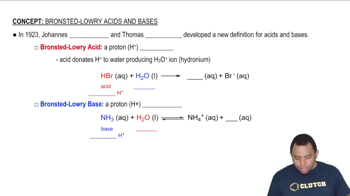
Brønsted–Lowry Acid-Base Theory

The Brønsted–Lowry theory defines acids as proton donors and bases as proton acceptors. This framework allows for the identification of acid-base reactions based on the transfer of protons (H+ ions) between species. Understanding this theory is essential for analyzing reactions and determining the roles of different substances in the reaction.
Video consigliato:
Percorso guidato
02:08
Bronsted-Lowry Acid-Base Theory

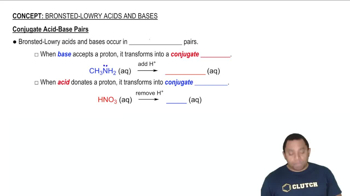
Conjugate Acid-Base Pairs

In the context of Brønsted–Lowry theory, a conjugate acid is formed when a base accepts a proton, while a conjugate base is formed when an acid donates a proton. These pairs are crucial for understanding the equilibrium of acid-base reactions, as they illustrate how substances can interchange roles depending on the reaction conditions.
Video consigliato:
Percorso guidato
01:30
Conjugate Acid-Base Pairs

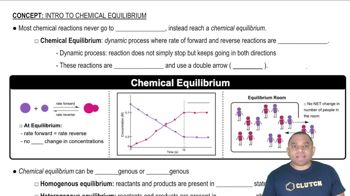
Chemical Equilibrium

Chemical equilibrium refers to the state in which the rates of the forward and reverse reactions are equal, resulting in constant concentrations of reactants and products. In acid-base reactions, this concept helps explain how the presence of acids and bases can shift the equilibrium position, affecting the concentrations of conjugate acids and bases in solution.
Video consigliato:
Percorso guidato
04:21
Chemical Equilibrium Concepts