Ch.16 - Acids and Bases
Tro - Chemistry: A Molecular Approach 4th Edition
Tro4th EditionChemistry: A Molecular ApproachISBN: 9780134112831Non è quello che usi tu?Cambia libro di testo
Capitolo 16, Problema 113

Is this question correctly formulated? If so, could you provide it as is; if not, modify it as needed and return it in JSON format: Calculate the concentration of all species in a 0.500 M solution of H2SO3.

Guida verificata passo dopo passo
1
insert step 1: Understand that H2SO3 is a diprotic acid, meaning it can donate two protons (H+ ions) in solution.
insert step 2: Write the dissociation equations for H2SO3. The first dissociation is H2SO3 ⇌ H+ + HSO3^-. The second dissociation is HSO3^- ⇌ H+ + SO3^2-.
insert step 3: Use the given initial concentration of H2SO3 (0.500 M) and set up an ICE (Initial, Change, Equilibrium) table for each dissociation step to track the changes in concentration.
insert step 4: Apply the equilibrium constant expressions for each dissociation step. For the first dissociation, use Ka1 = [H+][HSO3^-]/[H2SO3]. For the second dissociation, use Ka2 = [H+][SO3^2-]/[HSO3^-].
insert step 5: Solve the equilibrium expressions simultaneously to find the concentrations of all species: [H2SO3], [HSO3^-], [SO3^2-], and [H+].

Concetti chiave

Ecco i concetti essenziali che devi comprendere per rispondere correttamente alla domanda.

Concentration

Concentration refers to the amount of a substance (solute) present in a given volume of solution. It is commonly expressed in molarity (M), which is moles of solute per liter of solution. Understanding concentration is crucial for calculating the amounts of different species in a solution, especially in acid-base chemistry.
Video consigliato:
Percorso guidato
07:35
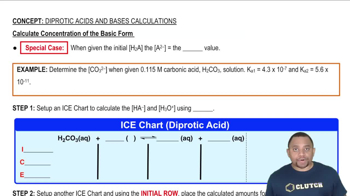
Calculate Concentration of the Basic Form

Dissociation of Acids

Dissociation of acids involves the process by which an acid releases protons (H+) into a solution. For weak acids like H2SO3 (sulfurous acid), this process is not complete, and the equilibrium between the undissociated acid and its ions must be considered. This concept is essential for determining the concentrations of all species in the solution.
Video consigliato:
Percorso guidato
00:54
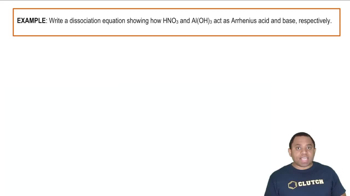
Acid-Base Dissociation Example

Equilibrium Constant (Ka)

The equilibrium constant (Ka) quantifies the extent of dissociation of a weak acid in solution. It is defined as the ratio of the concentration of the products (ions) to the concentration of the reactants (undissociated acid) at equilibrium. Knowing the Ka value for H2SO3 allows for the calculation of the concentrations of all species present in the solution.
Video consigliato:
Percorso guidato
01:14
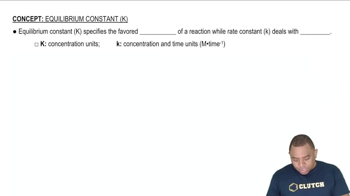
Equilibrium Constant K