Ch.16 - Acids and Bases
Tro - Chemistry: A Molecular Approach 4th Edition
Tro4th EditionChemistry: A Molecular ApproachISBN: 9780134112831Non è quello che usi tu?Cambia libro di testo
Capitolo 16, Problema 45a,b

Pick the stronger base from each pair. a. F– or Cl– b. NO2– or NO3–

Guida verificata passo dopo passo
1
Identify the periodic trend for halides: Fluoride (F–) and Chloride (Cl–) are both halide ions. In general, the basicity of halide ions decreases as you move down the group in the periodic table.
Compare the electronegativity: Fluoride is more electronegative than Chloride, which means it holds onto its electrons more tightly and is less willing to donate them, making it a weaker base.
Determine the conjugate acid strength: The strength of a base is inversely related to the strength of its conjugate acid. HF is a weaker acid than HCl, so F– is a stronger base than Cl–.
Analyze the resonance stabilization: For NO2– and NO3–, consider the resonance structures. NO3– has more resonance structures, which stabilizes the ion and makes it a weaker base.
Evaluate the conjugate acid strength for nitrites and nitrates: HNO3 is a stronger acid than HNO2, indicating that NO2– is a stronger base than NO3–.

Risposta video verificata per un problema simile:

Questa soluzione video è stata consigliata dai nostri tutor come utile per risolvere questo problema.
Durata del video:
1m

Concetti chiave

Ecco i concetti essenziali che devi comprendere per rispondere correttamente alla domanda.

Acid-Base Theory

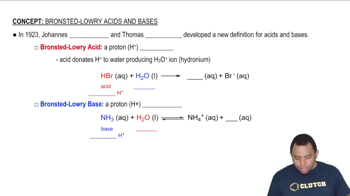
Acid-base theory explains the behavior of acids and bases in chemical reactions. According to the Brønsted-Lowry theory, an acid is a proton donor, while a base is a proton acceptor. The strength of a base is determined by its ability to accept protons, which is influenced by the stability of the resulting conjugate acid.
Video consigliato:
Percorso guidato
02:08
Bronsted-Lowry Acid-Base Theory

Conjugate Acid-Base Pairs

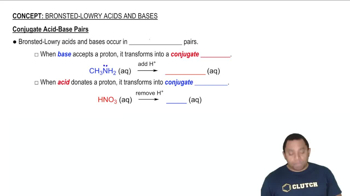
Conjugate acid-base pairs consist of two species that differ by the presence of a proton. When a base accepts a proton, it forms its conjugate acid, and the strength of the base can be inferred from the stability of its conjugate acid. A weaker conjugate acid indicates a stronger base, as it is less likely to donate a proton back.
Video consigliato:
Percorso guidato
01:30
Conjugate Acid-Base Pairs

Electronegativity and Basicity

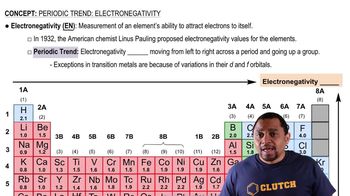
Electronegativity is the tendency of an atom to attract electrons in a bond. In the context of basicity, a more electronegative atom will hold onto its electrons more tightly, making it less likely to accept protons. Therefore, when comparing bases, the one with the less electronegative atom is typically the stronger base, as it can more readily accept protons.
Video consigliato:
Percorso guidato
02:10
Electronegativity Trends