Ch.16 - Acids and Bases
Tro - Chemistry: A Molecular Approach 4th Edition
Tro4th EditionChemistry: A Molecular ApproachISBN: 9780134112831Non è quello che usi tu?Cambia libro di testo
Capitolo 16, Problema 87

Write equations showing how each weak base ionizes water to form OH–. Also write the corresponding expression for Kb. a. NH3 b. HCO3– c. CH3NH2

Guida verificata passo dopo passo
1
Identify the weak base and its reaction with water. For each base, write the chemical equation showing the base accepting a proton from water to form its conjugate acid and hydroxide ion (OH^-).
For NH_3, write the equation: NH_3 + H_2O \(\rightleftharpoons\) NH_4^+ + OH^-.
For HCO_3^-, write the equation: HCO_3^- + H_2O \(\rightleftharpoons\) H_2CO_3 + OH^-.
For CH_3NH_2, write the equation: CH_3NH_2 + H_2O \(\rightleftharpoons\) CH_3NH_3^+ + OH^-.
Write the expression for the base dissociation constant (K_b) for each reaction. For example, for NH_3, K_b = \(\frac{[NH_4^+][OH^-]}{[NH_3]}\) and similarly for the others.

Risposta video verificata per un problema simile:

Questa soluzione video è stata consigliata dai nostri tutor come utile per risolvere questo problema.
Durata del video:
55s

Concetti chiave

Ecco i concetti essenziali che devi comprendere per rispondere correttamente alla domanda.

Ionization of Weak Bases

Weak bases partially ionize in water, meaning they do not completely dissociate into ions. For example, ammonia (NH3) reacts with water to form ammonium (NH4+) and hydroxide ions (OH–). This process is essential for understanding how weak bases contribute to the pH of a solution and the formation of hydroxide ions.
Video consigliato:
Percorso guidato
01:00
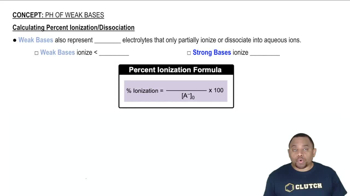
Calculating Percent Ionization of Weak Bases

Equilibrium Constant (Kb)

The base dissociation constant (Kb) quantifies the strength of a weak base in solution. It is defined as the ratio of the concentration of the products (the ions formed) to the concentration of the reactants (the un-ionized base) at equilibrium. A higher Kb value indicates a stronger weak base, which ionizes more in water.
Video consigliato:
Percorso guidato
01:14
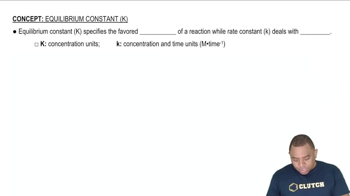
Equilibrium Constant K

Hydrolysis Reaction

Hydrolysis reactions occur when a base reacts with water to produce hydroxide ions. In the context of weak bases, this reaction is crucial for determining the pH of the solution. For example, when bicarbonate (HCO3–) acts as a weak base, it accepts a proton from water, leading to the formation of carbonate (CO3^2–) and hydroxide ions (OH–).
Video consigliato:
Percorso guidato
01:30
Alcohol Reactions: Dehydration Reactions