
Ch.17 - Aqueous Ionic Equilibrium
Tro - Chemistry: A Molecular Approach 4th Edition
Tro4th EditionChemistry: A Molecular ApproachISBN: 9780134112831Non è quello che usi tu?Cambia libro di testo
Capitolo 17, Problema 132

A 0.867-g sample of an unknown acid requires 32.2 mL of a 0.182 M barium hydroxide solution for neutralization. Assuming the acid is diprotic, calculate the molar mass of the acid.

Guida verificata passo dopo passo
1
Identify the balanced chemical equation for the neutralization reaction: \[ \text{H}_2\text{A} + \text{Ba(OH)}_2 \rightarrow \text{BaA} + 2\text{H}_2\text{O} \] where H\(_2\)A represents the diprotic acid.
Calculate the moles of barium hydroxide (Ba(OH)\(_2\)) used in the reaction using the formula: \[ \text{moles of Ba(OH)}_2 = \text{Molarity} \times \text{Volume in Liters} \]
Use the stoichiometry of the balanced equation to determine the moles of the diprotic acid (H\(_2\)A). Since one mole of Ba(OH)\(_2\) reacts with one mole of H\(_2\)A, the moles of H\(_2\)A are equal to the moles of Ba(OH)\(_2\).
Calculate the molar mass of the acid using the formula: \[ \text{Molar Mass} = \frac{\text{mass of the acid sample}}{\text{moles of the acid}} \]
Substitute the known values into the molar mass formula to find the molar mass of the unknown diprotic acid.

Risposta video verificata per un problema simile:

Questa soluzione video è stata consigliata dai nostri tutor come utile per risolvere questo problema.
Durata del video:
1m

Concetti chiave

Ecco i concetti essenziali che devi comprendere per rispondere correttamente alla domanda.

Neutralization Reaction

A neutralization reaction occurs when an acid reacts with a base to produce water and a salt. In this case, barium hydroxide (a strong base) neutralizes the diprotic acid, meaning it can donate two protons (H+ ions). The stoichiometry of the reaction is crucial for determining the amount of acid present based on the volume and concentration of the base used.
Video consigliato:
Percorso guidato
05:56
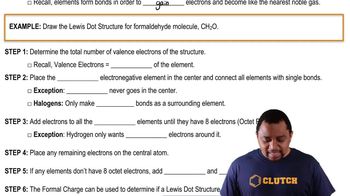
Lewis Dot Structures: Neutral Compounds

Diprotic Acids

Diprotic acids are acids that can donate two protons (H+) per molecule during a reaction. This property affects the stoichiometry of the neutralization reaction, as two moles of base are required to neutralize one mole of diprotic acid. Understanding this concept is essential for calculating the moles of acid from the moles of base used in the reaction.
Video consigliato:
Percorso guidato
04:40
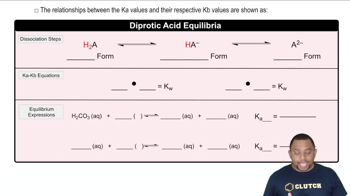
3 forms of Diprotic Acids

Molar Mass Calculation

Molar mass is the mass of one mole of a substance, typically expressed in grams per mole (g/mol). To find the molar mass of the unknown acid, the total mass of the acid sample is divided by the number of moles of acid present, which can be derived from the volume and concentration of the neutralizing base. This calculation is fundamental in determining the identity and properties of the acid.
Video consigliato:
Percorso guidato
03:12
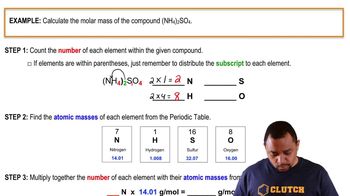
Molar Mass Calculation Example