A 30.0-mL sample of 0.165 M propanoic acid is titrated with 0.300 M KOH. Calculate the pH at each volume of added base: 10 mL.
Ch.17 - Aqueous Ionic Equilibrium
Tro4th EditionChemistry: A Molecular ApproachISBN: 9780134112831Non è quello che usi tu?Cambia libro di testo
Capitolo 17, Problema 72
A 30.0-mL sample of 0.165 M propanoic acid is titrated with 0.300 M KOH. Calculate the pH at each volume of added base: 0 mL, 5 mL, 10 mL, equivalence point, one-half equivalence point, 20 mL, 25 mL. Sketch the titration curve.

Guida verificata passo dopo passo1
Step 1: Calculate the initial moles of propanoic acid (C2H5COOH) using the formula: moles = Molarity × Volume.
Step 2: For each volume of KOH added, calculate the moles of KOH added using the formula: moles = Molarity × Volume.
Step 3: Determine the moles of propanoic acid and its conjugate base (propanoate ion, C2H5COO-) after the reaction with KOH using stoichiometry.
Step 4: Use the Henderson-Hasselbalch equation to calculate the pH at each point where the buffer region is applicable: pH = pKa + log([A-]/[HA]).
Step 5: For the equivalence point and beyond, calculate the pH based on the concentration of the excess strong base (KOH) in the solution.

Risposta video verificata per un problema simile:
Questa soluzione video è stata consigliata dai nostri tutor come utile per risolvere questo problema.
Durata del video:
20mConcetti chiave
Ecco i concetti essenziali che devi comprendere per rispondere correttamente alla domanda.
Titration
Titration is a quantitative analytical technique used to determine the concentration of a solute in a solution. It involves the gradual addition of a titrant (in this case, KOH) to a solution of the analyte (propanoic acid) until the reaction reaches its equivalence point, where the amount of titrant added is stoichiometrically equivalent to the amount of substance in the analyte.
Video consigliato:
Percorso guidato
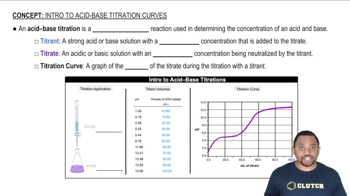
Acid-Base Titration
pH and Acid-Base Neutralization
pH is a measure of the acidity or basicity of a solution, with lower values indicating acidic conditions and higher values indicating basic conditions. During a titration of a weak acid like propanoic acid with a strong base like KOH, the pH changes significantly, especially around the equivalence point, where the acid is completely neutralized, resulting in a sharp increase in pH.
Video consigliato:
Percorso guidato
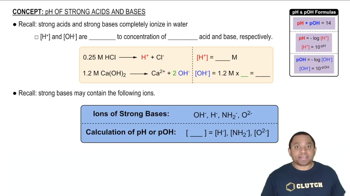
pH of Strong Acids and Bases
Titration Curve
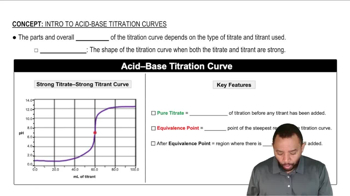
A titration curve is a graphical representation of the pH of a solution as a function of the volume of titrant added. It typically shows a gradual increase in pH at first, followed by a steep rise near the equivalence point, and then levels off. The shape of the curve provides insights into the strength of the acid and base involved, as well as the equivalence and half-equivalence points.
Video consigliato:
Percorso guidato
Acid-Base Titration Curves
Pratica correlata
Domanda del libro di testo
370
views
Domanda del libro di testo
Consider the titration of a 20.0-mL sample of 0.105 M HC2H3O2 with 0.125 M NaOH. Determine each quantity. b. the volume of added base required to reach the equivalence point
1870
views
2
rank
Domanda del libro di testo
Consider the titration of a 25.0-mL sample of 0.115 M RbOH with 0.100 M HCl. Determine each quantity. b. the volume of added acid required to reach the equivalence point
1481
views
Domanda del libro di testo
Consider the titration of a 25.0-mL sample of 0.115 M RbOH with 0.100 M HCl. Determine each quantity. c. the pH at 5.0 mL of added acid
1921
views
Domanda del libro di testo
A 30.0-mL sample of 0.165 M propanoic acid is titrated with 0.300 M KOH. Calculate the pH at each volume of added base: 0 mL.
322
views
Domanda del libro di testo
A 30.0-mL sample of 0.165 M propanoic acid is titrated with 0.300 M KOH. Calculate the pH at each volume of added base: 5 mL.
325
views