
Ch.17 - Aqueous Ionic Equilibrium
Tro - Chemistry: A Molecular Approach 4th Edition
Tro4th EditionChemistry: A Molecular ApproachISBN: 9780134112831Non è quello che usi tu?Cambia libro di testo
Capitolo 17, Problema 122

A 5.55-g sample of a weak acid with Ka = 1.3⨉10-4 was combined with 5.00 mL of 6.00 M NaOH, and the resulting solution was diluted to 750.0 mL. The measured pH of the solution was 4.25. What is the molar mass of the weak acid?

Guida verificata passo dopo passo
1
First, calculate the moles of NaOH used in the reaction. The molarity of a solution is defined as the moles of solute divided by the volume of the solution in liters. Therefore, to find the moles of NaOH, multiply the volume of the NaOH solution (in liters) by its molarity.
Next, determine the moles of the weak acid. Since NaOH is a strong base, it will react completely with the weak acid in a 1:1 ratio. Therefore, the moles of the weak acid will be equal to the moles of NaOH.
Then, calculate the concentration of the weak acid in the final solution. The concentration is defined as the moles of solute divided by the volume of the solution in liters. In this case, divide the moles of the weak acid by the final volume of the solution (in liters).
Now, use the pH and the acid dissociation constant (Ka) to calculate the concentration of the acid that did not react with NaOH. The pH is a measure of the concentration of H+ ions in the solution, and the Ka is a measure of the degree to which the acid dissociates. Use the equation pH = -log[H+] and the expression for Ka, which is [H+][A-]/[HA], to solve for [HA], the concentration of the non-dissociated acid.
Finally, calculate the molar mass of the weak acid. The molar mass is the mass of the substance divided by the number of moles. In this case, divide the mass of the weak acid (in grams) by the moles of the weak acid that did not react with NaOH.

Risposta video verificata per un problema simile:

Questa soluzione video è stata consigliata dai nostri tutor come utile per risolvere questo problema.
Durata del video:
9m

Concetti chiave

Ecco i concetti essenziali che devi comprendere per rispondere correttamente alla domanda.

Weak Acids and Their Dissociation

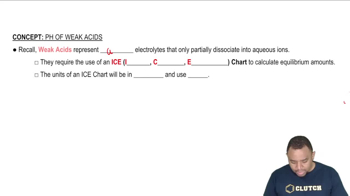
Weak acids partially dissociate in solution, establishing an equilibrium between the undissociated acid and its ions. The acid dissociation constant (Ka) quantifies this equilibrium, indicating the strength of the acid. A lower Ka value signifies a weaker acid, which is crucial for understanding how the acid behaves in a reaction with a strong base like NaOH.
Video consigliato:
Percorso guidato
00:44
ICE Charts of Weak Acids

Neutralization Reactions

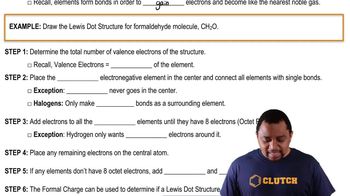
Neutralization reactions occur when an acid reacts with a base to form water and a salt. In this case, the weak acid reacts with NaOH, a strong base, leading to the formation of water and the conjugate base of the weak acid. The stoichiometry of the reaction is essential for determining the amount of acid neutralized and, subsequently, the molar mass of the weak acid.
Video consigliato:
Percorso guidato
05:56
Lewis Dot Structures: Neutral Compounds

pH and Concentration Relationships

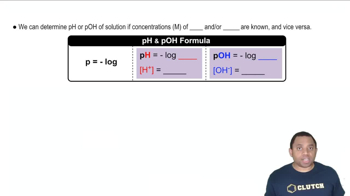
The pH of a solution is a measure of its hydrogen ion concentration, which is critical for understanding the behavior of acids and bases. The pH can be calculated using the formula pH = -log[H+]. In this scenario, the measured pH of 4.25 allows for the determination of the concentration of hydrogen ions, which can be used to find the amount of weak acid present in the solution after dilution.
Video consigliato:
Percorso guidato
02:09
pH and pOH Calculations