Ch.17 - Aqueous Ionic Equilibrium
Tro - Chemistry: A Molecular Approach 4th Edition
Tro4th EditionChemistry: A Molecular ApproachISBN: 9780134112831Non è quello che usi tu?Cambia libro di testo
Capitolo 17, Problema 97a

Calculate the molar solubility of calcium hydroxide in a solution buffered at each pH. a. pH = 4

Guida verificata passo dopo passo
1
Identify the chemical formula for calcium hydroxide, which is \(Ca(OH)_2\). This compound dissociates in water according to the equation: \(Ca(OH)_2(s) \rightarrow Ca^{2+}(aq) + 2OH^{-}(aq)\).
Write the expression for the solubility product constant (Ksp) of calcium hydroxide. The Ksp expression is given by \(K_{sp} = [Ca^{2+}][OH^{-}]^2\).
Recognize that the pH of the solution provides information about the concentration of hydroxide ions, \([OH^{-}]\). Calculate \([OH^{-}]\) using the formula \([OH^{-}] = 10^{-14} / [H^{+}]\), where \([H^{+}] = 10^{-pH}\). For pH = 4, calculate \([H^{+}]\) and then \([OH^{-}]\).
Substitute the \([OH^{-}]\) value from step 3 into the Ksp expression. Since the concentration of \(OH^{-}\) ions is known, you can rearrange the Ksp expression to solve for \([Ca^{2+}]\), which represents the molar solubility of \(Ca(OH)_2\) in terms of \([Ca^{2+}]\).
Finally, use the stoichiometry of the dissociation reaction to find the molar solubility of \(Ca(OH)_2\). Since the dissolution of \(Ca(OH)_2\) produces one mole of \(Ca^{2+}\) ions for each mole of \(Ca(OH)_2\) that dissolves, the molar solubility of \(Ca(OH)_2\) is equal to \([Ca^{2+}]\).

Risposta video verificata per un problema simile:

Questa soluzione video è stata consigliata dai nostri tutor come utile per risolvere questo problema.

Concetti chiave

Ecco i concetti essenziali che devi comprendere per rispondere correttamente alla domanda.

Molar Solubility

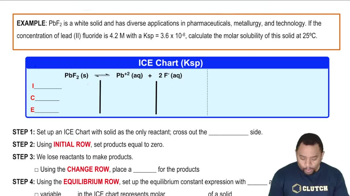
Molar solubility refers to the maximum amount of a solute that can dissolve in a given volume of solvent at a specific temperature, expressed in moles per liter (mol/L). For calcium hydroxide (Ca(OH)2), which is a sparingly soluble salt, its molar solubility can be influenced by the pH of the solution, as it dissociates into calcium ions (Ca²⁺) and hydroxide ions (OH⁻).
Video consigliato:
Percorso guidato
04:13
Molar Solubility Example

pH and Hydroxide Ion Concentration

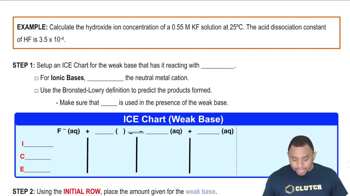
pH is a measure of the acidity or basicity of a solution, with lower values indicating higher acidity. In a buffered solution at pH 4, the concentration of hydrogen ions (H⁺) is high, which can affect the solubility of calcium hydroxide by shifting the equilibrium of its dissociation. The relationship between pH and hydroxide ion concentration (OH⁻) is crucial, as higher H⁺ concentrations can suppress the formation of OH⁻ ions, thereby influencing solubility.
Video consigliato:
Percorso guidato
06:12
Hydroxide Ion Concentration Example

Le Chatelier's Principle

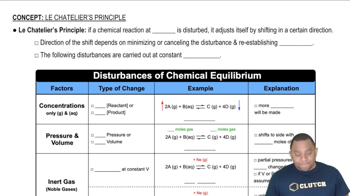
Le Chatelier's Principle states that if a dynamic equilibrium is disturbed by changing the conditions, the system will adjust to counteract the change and restore a new equilibrium. In the context of calcium hydroxide solubility, adding H⁺ ions (by lowering pH) shifts the equilibrium towards the solid form of Ca(OH)2, reducing its solubility. Understanding this principle is essential for predicting how changes in pH will affect the molar solubility of the compound.
Video consigliato:
Percorso guidato
07:32
Le Chatelier's Principle