Ch.17 - Aqueous Ionic Equilibrium
Tro - Chemistry: A Molecular Approach 4th Edition
Tro4th EditionChemistry: A Molecular ApproachISBN: 9780134112831Non è quello che usi tu?Cambia libro di testo
Capitolo 17, Problema 31

Calculate the percent ionization of a 0.15 M benzoic acid solution in pure water and in a solution containing 0.10 M sodium benzoate. Why does the percent ionization differ significantly in the two solutions?

Guida verificata passo dopo passo
1
Step 1: Write the chemical equation for the ionization of benzoic acid (C6H5COOH) in water.
Step 2: Use the expression for the acid dissociation constant (Ka) of benzoic acid to set up the equilibrium expression: Ka = [C6H5COO^-][H^+]/[C6H5COOH].
Step 3: For the pure water solution, assume initial concentrations and changes in concentration at equilibrium to solve for [H^+] and calculate percent ionization: % ionization = ([H^+]/[C6H5COOH_initial]) * 100.
Step 4: For the solution containing sodium benzoate, apply the common ion effect. Sodium benzoate provides additional benzoate ions (C6H5COO^-), which affects the equilibrium position. Set up the modified equilibrium expression and solve for [H^+].
Step 5: Calculate the percent ionization in the sodium benzoate solution and compare it to the pure water solution. Explain that the presence of the common ion (C6H5COO^-) suppresses the ionization of benzoic acid, leading to a lower percent ionization.

Risposta video verificata per un problema simile:

Questa soluzione video è stata consigliata dai nostri tutor come utile per risolvere questo problema.
Durata del video:
6m

Concetti chiave

Ecco i concetti essenziali che devi comprendere per rispondere correttamente alla domanda.

Ionization of Weak Acids

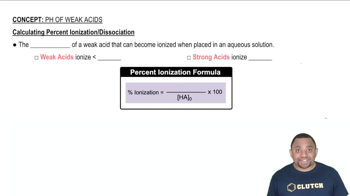
Weak acids, like benzoic acid, do not completely dissociate in solution. Instead, they establish an equilibrium between the undissociated acid and its ions. The degree of ionization is influenced by the concentration of the acid and the presence of other species in the solution.
Video consigliato:
Percorso guidato
01:15
Calculating Percent Ionization of Weak Acids

Common Ion Effect

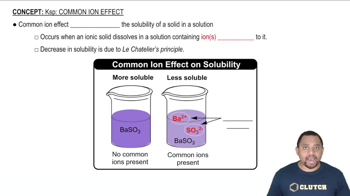
The common ion effect describes how the addition of a salt containing an ion common to a weak acid suppresses its ionization. In the case of benzoic acid and sodium benzoate, the benzoate ion from sodium benzoate shifts the equilibrium, reducing the percent ionization of benzoic acid in the solution.
Video consigliato:
Percorso guidato
02:53
Common Ion Effect

Percent Ionization Calculation

Percent ionization is calculated by dividing the concentration of ionized acid by the initial concentration of the acid, then multiplying by 100. This metric helps quantify how much of the acid has dissociated into ions, providing insight into the acid's strength and behavior in different environments.
Video consigliato:
Percorso guidato
01:15
Calculating Percent Ionization of Weak Acids