
Ch.17 - Aqueous Ionic Equilibrium
Tro - Chemistry: A Molecular Approach 4th Edition
Tro4th EditionChemistry: A Molecular ApproachISBN: 9780134112831Non è quello che usi tu?Cambia libro di testo
Capitolo 17, Problema 66d

Consider the curve shown here for the titration of a weak base with a strong acid and answer each question.
d. At what volume of added acid is the pH calculated by working an equilibrium problem based on the concentration and Ka of the conjugate acid?

Guida verificata passo dopo passo
1
1. The pH at any point during a titration can be calculated by considering the dominant form of the species in solution and the equilibrium it establishes. However, the specific point in the titration where the pH is calculated by working an equilibrium problem based on the concentration and \(K_a\) of the conjugate acid is at the half-equivalence point.
2. The half-equivalence point is the point at which half of the weak base has been neutralized by the strong acid. At this point, the concentration of the weak base is equal to the concentration of its conjugate acid.
3. To find the volume of added acid at the half-equivalence point, you would first need to know the initial concentration of the weak base and the volume of the weak base solution. You would then use the stoichiometry of the neutralization reaction to calculate the volume of the strong acid solution needed to react with half of the weak base.
4. Once you have the volume of the strong acid at the half-equivalence point, you can calculate the pH by setting up an equilibrium expression for the reaction of the conjugate acid with water (the hydrolysis reaction). The \(K_a\) for this reaction is the acid dissociation constant of the conjugate acid.
5. Solve the equilibrium expression for the hydronium ion concentration, and then use the definition of pH ($pH = -log[H_3O^+]$) to calculate the pH.

Risposta video verificata per un problema simile:

Questa soluzione video è stata consigliata dai nostri tutor come utile per risolvere questo problema.
Durata del video:
2m

Concetti chiave

Ecco i concetti essenziali che devi comprendere per rispondere correttamente alla domanda.

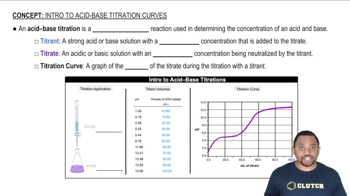
Titration

Titration is a quantitative analytical technique used to determine the concentration of a solute in a solution. In this context, it involves the gradual addition of a strong acid to a weak base, allowing for the observation of pH changes. The equivalence point, where the amount of acid equals the amount of base, is critical for calculating the resulting pH and understanding the acid-base reaction.
Video consigliato:
Percorso guidato
03:04
Acid-Base Titration

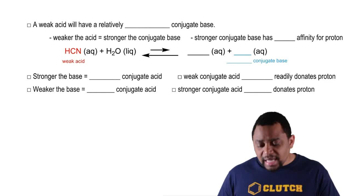
Weak Base and Conjugate Acid

A weak base is a substance that partially ionizes in solution, establishing an equilibrium between the base and its conjugate acid. The conjugate acid is formed when the weak base accepts a proton (H+). Understanding the relationship between a weak base and its conjugate acid is essential for calculating pH at various points in the titration, particularly after the addition of acid.
Video consigliato:
Percorso guidato
01:46
Conjugate Acid-Base Relationships

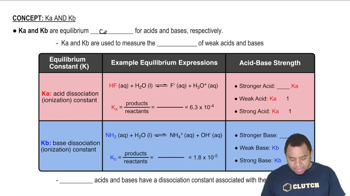
Equilibrium and Ka

Equilibrium in a chemical reaction refers to the state where the rates of the forward and reverse reactions are equal, resulting in constant concentrations of reactants and products. The acid dissociation constant (Ka) quantifies the strength of a weak acid, indicating how well it donates protons in solution. In titration, after a certain volume of acid is added, the pH can be calculated using the equilibrium concentrations and the Ka of the conjugate acid formed.
Video consigliato:
Percorso guidato
03:50
Characteristics of Ka and Kb