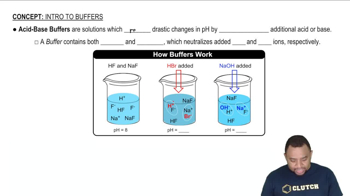
A buffer contains significant amounts of acetic acid and sodium acetate. Write equations showing how this buffer neutralizes added acid and added base.
Ch.17 - Aqueous Ionic Equilibrium
Tro4th EditionChemistry: A Molecular ApproachISBN: 9780134112831Non è quello che usi tu?Cambia libro di testo
Capitolo 17, Problema 38
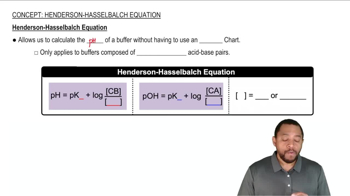
Use the Henderson–Hasselbalch equation to calculate the pH of each solution in Problem 30.
Guida verificata passo dopo passo1
Identify the components of the buffer solution: the weak acid (HA) and its conjugate base (A^-).
Determine the concentrations of the weak acid [HA] and its conjugate base [A^-] in the solution.
Find the pKa of the weak acid. This can often be found in a table of acid dissociation constants.
Use the Henderson–Hasselbalch equation: \( \text{pH} = \text{pKa} + \log \left( \frac{[A^-]}{[HA]} \right) \).
Substitute the values of pKa, [A^-], and [HA] into the equation to calculate the pH.
Concetti chiave
Ecco i concetti essenziali che devi comprendere per rispondere correttamente alla domanda.
Henderson-Hasselbalch Equation
The Henderson-Hasselbalch equation is a mathematical formula used to calculate the pH of a buffer solution. It relates the pH of the solution to the pKa of the acid and the ratio of the concentrations of the conjugate base to the acid. The equation is expressed as pH = pKa + log([A-]/[HA]), where [A-] is the concentration of the base and [HA] is the concentration of the acid.
Video consigliato:
Percorso guidato
Henderson-Hasselbalch Equation
Buffer Solutions
Buffer solutions are mixtures that can resist changes in pH when small amounts of acid or base are added. They typically consist of a weak acid and its conjugate base or a weak base and its conjugate acid. Understanding how buffers work is essential for applying the Henderson-Hasselbalch equation, as it helps in determining how the pH will change in response to the addition of acids or bases.
Video consigliato:
Percorso guidato
Buffer Solutions
pKa and Acid-Base Equilibrium
The pKa is a measure of the strength of an acid in solution, defined as the negative logarithm of the acid dissociation constant (Ka). It indicates the pH at which half of the acid is dissociated into its conjugate base. Knowing the pKa of the acid involved in the buffer system is crucial for using the Henderson-Hasselbalch equation effectively, as it helps predict the pH based on the concentrations of the acid and its conjugate base.
Video consigliato:
Percorso guidato
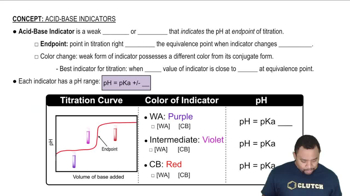
Acid-Base Indicators
Pratica correlata
Domanda del libro di testo
2830
views
Domanda del libro di testo
Calculate the pH of the solution that results from each mixture. a. 50.0 mL of 0.15 M HCHO2 with 75.0 mL of 0.13 M NaCHO2
4284
views
1
rank
Domanda del libro di testo
A buffer contains significant amounts of ammonia and ammonium chloride. Write equations showing how this buffer neutralizes added acid and added base.
1687
views
Domanda del libro di testo
Use the Henderson–Hasselbalch equation to calculate the pH of each solution in Problem 29.
968
views
Domanda del libro di testo
Use the Henderson–Hasselbalch equation to calculate the pH of each solution. c. a solution that contains 10.0 g of HC2H3O2 and 10.0 g of NaC2H3O2 in 150.0 mL of solution
3757
views
1
rank
1
comments
Domanda del libro di testo
Calculate the pH of the solution that results from each mixture. b. 125.0 mL of 0.10 M NH3 with 250.0 mL of 0.10 M NH4Cl
1295
views