Without doing any calculations, determine the sign of ΔSsys for each chemical reaction. a. 2 KClO3(s) → 2 KCl(s) + 3 O2(g) c. Na(s) + 2 Cl2(g) → NaCl(s) d. N2(g) + 3 H2(g) → 2 NH3(g)
Ch.18 - Free Energy and Thermodynamics
Tro4th EditionChemistry: A Molecular ApproachISBN: 9780134112831Non è quello che usi tu?Cambia libro di testo
Capitolo 18, Problema 37a
Without doing any calculations, determine the signs of ΔSsys and ΔS surr for each chemical reaction. In addition, predict under what temperatures (all temperatures, low temperatures, or high temperatures), if any, the reaction is spontaneous. a. C3H8(g) + 5 O2(g) → 3 CO2(g) + 4 H2O(g) ΔH°rxn = -2044 kJ
Guida verificata passo dopo passo1
Identify the type of reaction: The given reaction is a combustion reaction, which typically involves the reaction of a hydrocarbon with oxygen to produce carbon dioxide and water.
Determine the sign of \( \Delta S_{\text{sys}} \): In this reaction, the number of moles of gas decreases from 6 moles (1 mole of C\(_3\)H\(_8\) and 5 moles of O\(_2\)) to 7 moles (3 moles of CO\(_2\) and 4 moles of H\(_2\)O). Since the number of gas molecules increases, \( \Delta S_{\text{sys}} \) is likely positive.
Determine the sign of \( \Delta S_{\text{surr}} \): The reaction is exothermic (\( \Delta H^\circ_{\text{rxn}} = -2044 \text{ kJ} \)), which means heat is released to the surroundings, increasing the entropy of the surroundings. Therefore, \( \Delta S_{\text{surr}} \) is positive.
Predict the spontaneity of the reaction: For a reaction to be spontaneous, the total entropy change (\( \Delta S_{\text{univ}} = \Delta S_{\text{sys}} + \Delta S_{\text{surr}} \)) must be positive. Since both \( \Delta S_{\text{sys}} \) and \( \Delta S_{\text{surr}} \) are positive, the reaction is spontaneous at all temperatures.
Summarize the findings: The reaction has \( \Delta S_{\text{sys}} > 0 \) and \( \Delta S_{\text{surr}} > 0 \), making it spontaneous at all temperatures.

Risposta video verificata per un problema simile:
Questa soluzione video è stata consigliata dai nostri tutor come utile per risolvere questo problema.
Concetti chiave
Ecco i concetti essenziali che devi comprendere per rispondere correttamente alla domanda.
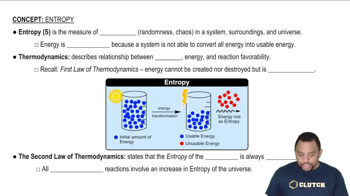
Entropy (ΔS)
Entropy, represented as ΔS, is a measure of the disorder or randomness in a system. In chemical reactions, an increase in the number of gas molecules or a transition from a solid to a liquid or gas typically results in a positive ΔS, indicating greater disorder. Conversely, reactions that produce fewer gas molecules or involve the formation of solids from gases usually have a negative ΔS.
Video consigliato:
Percorso guidato
Entropy in Thermodynamics
Enthalpy (ΔH) and Spontaneity
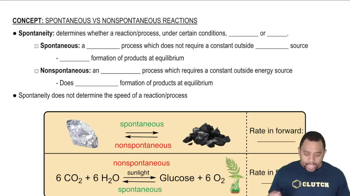
Enthalpy change (ΔH) reflects the heat absorbed or released during a reaction. A negative ΔH indicates an exothermic reaction, which tends to favor spontaneity. The spontaneity of a reaction can be assessed using Gibbs free energy (ΔG = ΔH - TΔS), where a negative ΔG indicates a spontaneous process. The interplay between ΔH and ΔS is crucial in determining the conditions under which a reaction is spontaneous.
Video consigliato:
Percorso guidato
Spontaneity of Processes
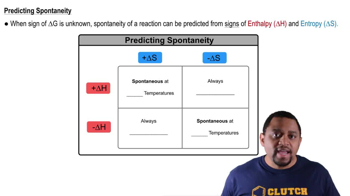
Temperature's Role in Spontaneity
Temperature plays a significant role in determining the spontaneity of a reaction, particularly when considering the signs of ΔH and ΔS. At high temperatures, reactions with positive ΔS may become spontaneous even if ΔH is positive, as the TΔS term can outweigh ΔH. Conversely, at low temperatures, reactions with negative ΔS may be spontaneous if ΔH is sufficiently negative, highlighting the importance of temperature in the Gibbs free energy equation.
Video consigliato:
Percorso guidato
Spontaneity and Temperature
Pratica correlata
Domanda del libro di testo
3407
views
Domanda del libro di testo
Without doing any calculations, determine the sign of ΔSsys for each chemical reaction. a. Mg(s) + Cl2(g) → MgCl2(s) b. 2 H2S(g) + 3 O2(g) → 2 H2O(g) + 2 SO2(g) c. 2 O3(g) → 3 O2(g) d. HCl(g) + NH3(g) → NH4Cl(s)
Domanda del libro di testo
Without doing any calculations, determine the signs of ΔSsys and ΔSsurr for each chemical reaction. In addition, predict under what temperatures (all temperatures, low temperatures, or high temperatures), if any, the reaction is spontaneous. c. 2 N2(g) + O2(g) → 2 N2O(g) ΔH°rxn = +163.2 kJ
596
views
Domanda del libro di testo
Without doing any calculations, determine the sign of ΔSsys for each chemical reaction. b. CH2=CH2( g) + H2( g) → CH3CH3( g)
463
views
1
rank