
Given the values of ΔH°rxn, ΔS°rxn, and T, determine ΔSuniv and predict whether or not each reaction is spontaneous. (Assume that all reactants and products are in their standard states.) c. ΔH°rxn = -115 kJ; ΔS°rxn = -263 J/K; T = 298 K
Ch.18 - Free Energy and Thermodynamics
Tro4th EditionChemistry: A Molecular ApproachISBN: 9780134112831Non è quello che usi tu?Cambia libro di testo
Capitolo 18, Problema 39d
Calculate ΔSsurr at the indicated temperature for each reaction. d. ΔH°rxn = +114 kJ; 77 K
Guida verificata passo dopo passo1
Identify the formula to calculate the change in entropy of the surroundings, which is given by \( \Delta S_{\text{surr}} = -\frac{\Delta H_{\text{rxn}}}{T} \).
Note that \( \Delta H_{\text{rxn}} \) is given as +114 kJ. Since entropy is typically expressed in J/K, convert \( \Delta H_{\text{rxn}} \) from kJ to J by multiplying by 1000.
The temperature \( T \) is given as 77 K. Ensure that the temperature is in Kelvin, which it is in this case.
Substitute the values into the formula: \( \Delta S_{\text{surr}} = -\frac{114,000 \text{ J}}{77 \text{ K}} \).
Simplify the expression to find \( \Delta S_{\text{surr}} \).

Risposta video verificata per un problema simile:
Questa soluzione video è stata consigliata dai nostri tutor come utile per risolvere questo problema.
Durata del video:
1mConcetti chiave
Ecco i concetti essenziali che devi comprendere per rispondere correttamente alla domanda.
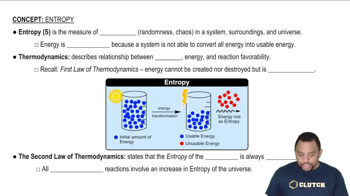
Entropy (ΔS)
Entropy is a measure of the disorder or randomness in a system. In thermodynamics, it quantifies the amount of energy in a physical system that is not available to do work. A positive change in entropy (ΔS > 0) indicates an increase in disorder, while a negative change (ΔS < 0) suggests a decrease in disorder. Understanding entropy is crucial for predicting the spontaneity of reactions.
Video consigliato:
Percorso guidato
Entropy in Thermodynamics
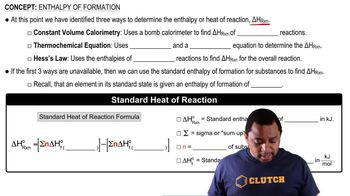
Enthalpy (ΔH)
Enthalpy is a thermodynamic property that reflects the total heat content of a system. It is defined as the internal energy plus the product of pressure and volume (H = U + PV). The change in enthalpy (ΔH) during a reaction indicates whether the reaction is exothermic (ΔH < 0) or endothermic (ΔH > 0). This concept is essential for calculating the surrounding entropy (ΔS surr) using the relationship between enthalpy and temperature.
Video consigliato:
Percorso guidato
Enthalpy of Formation
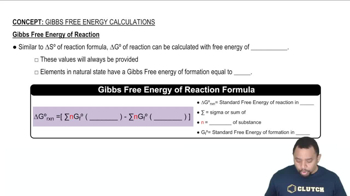
Gibbs Free Energy and Surrounding Entropy
The Gibbs free energy (G) combines enthalpy and entropy to determine the spontaneity of a reaction at constant temperature and pressure. The relationship ΔG = ΔH - TΔS allows us to calculate the change in entropy of the surroundings (ΔS surr) using the enthalpy change and the temperature. A reaction is spontaneous if ΔG is negative, which is influenced by both ΔH and ΔS surr.
Video consigliato:
Percorso guidato
Gibbs Free Energy of Reactions
Pratica correlata
Domanda del libro di testo
1060
views
Domanda del libro di testo
Without doing any calculations, determine the signs of ΔSsys and ΔSsurr for each chemical reaction. In addition, predict under what temperatures (all temperatures, low temperatures, or high temperatures), if any, the reaction is spontaneous. c. 2 N2(g) + O2(g) → 2 N2O(g) ΔH°rxn = +163.2 kJ
596
views
Domanda del libro di testo
Given the values of ΔH°rxn, ΔS°rxn, and T, determine ΔSuniv and predict whether or not each reaction is spontaneous. (Assume that all reactants and products are in their standard states.) a. ΔH°rxn = +115 kJ; ΔS°rxn = -263 J/K; T = 298 K
1477
views
1
comments
