
Ch.18 - Free Energy and Thermodynamics
Tro - Chemistry: A Molecular Approach 4th Edition
Tro4th EditionChemistry: A Molecular ApproachISBN: 9780134112831Non è quello che usi tu?Cambia libro di testo
Capitolo 18, Problema 45

Calculate the free energy change for this reaction at 25 °C. Is the reaction spontaneous? (Assume that all reactants and products are in their standard states.) C3H8(g) + 5 O2(g) → 3 CO2(g) + 4 H2O(g) ΔH°rxn = -2217 kJ; ΔS°rxn = 101.1 J/K

Guida verificata passo dopo passo
1
Identify the given values: \( \Delta H^\circ_{\text{rxn}} = -2217 \text{ kJ} \) and \( \Delta S^\circ_{\text{rxn}} = 101.1 \text{ J/K} \).
Convert \( \Delta S^\circ_{\text{rxn}} \) from \( \text{J/K} \) to \( \text{kJ/K} \) by dividing by 1000: \( \Delta S^\circ_{\text{rxn}} = 0.1011 \text{ kJ/K} \).
Use the Gibbs free energy equation: \( \Delta G^\circ = \Delta H^\circ - T \Delta S^\circ \).
Substitute the values into the equation: \( \Delta G^\circ = -2217 \text{ kJ} - (298 \text{ K} \times 0.1011 \text{ kJ/K}) \).
Determine if the reaction is spontaneous by checking the sign of \( \Delta G^\circ \): if \( \Delta G^\circ < 0 \), the reaction is spontaneous.

Risposta video verificata per un problema simile:

Questa soluzione video è stata consigliata dai nostri tutor come utile per risolvere questo problema.
Durata del video:
3m

Concetti chiave

Ecco i concetti essenziali che devi comprendere per rispondere correttamente alla domanda.

Gibbs Free Energy

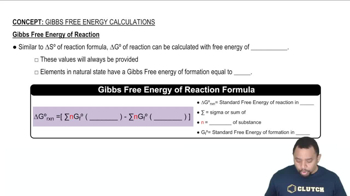
Gibbs Free Energy (G) is a thermodynamic potential that measures the maximum reversible work obtainable from a thermodynamic system at constant temperature and pressure. The change in Gibbs Free Energy (ΔG) for a reaction can be calculated using the equation ΔG = ΔH - TΔS, where ΔH is the change in enthalpy, T is the temperature in Kelvin, and ΔS is the change in entropy. A negative ΔG indicates that a reaction is spontaneous under the given conditions.
Video consigliato:
Percorso guidato
01:51
Gibbs Free Energy of Reactions

Standard State Conditions

Standard state conditions refer to a set of specific conditions used to measure the properties of substances, typically defined as 1 bar of pressure and a specified temperature, usually 25 °C (298 K). Under these conditions, the standard enthalpy (ΔH°) and standard entropy (ΔS°) values are determined for reactants and products. These values are essential for calculating the Gibbs Free Energy change for reactions, as they provide a reference point for the thermodynamic properties.
Video consigliato:
Percorso guidato
01:10
Standard Reduction Potentials

Spontaneity of Reactions

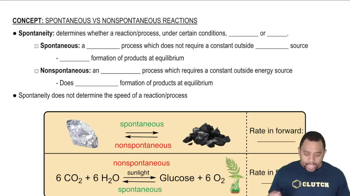
The spontaneity of a chemical reaction is determined by the sign of the Gibbs Free Energy change (ΔG). If ΔG is negative, the reaction is spontaneous, meaning it can occur without external energy input. Conversely, if ΔG is positive, the reaction is non-spontaneous and requires energy to proceed. Understanding the relationship between ΔG, ΔH, and ΔS helps predict whether a reaction will occur under specific conditions.
Video consigliato:
Percorso guidato
04:20
Spontaneity of Processes