
Ch.18 - Free Energy and Thermodynamics
Tro - Chemistry: A Molecular Approach 4th Edition
Tro4th EditionChemistry: A Molecular ApproachISBN: 9780134112831Non è quello che usi tu?Cambia libro di testo
Capitolo 18, Problema 65b

Consider the reaction: 2 NO(g) + O2(g) → 2 NO2(g) Estimate ΔG° for this reaction at each temperature and predict whether or not the reaction is spontaneous. (Assume that ΔH° and ΔS° do not change too much within the given temperature range.) b. 715 K

Guida verificata passo dopo passo
1
Identify the given reaction: \(2 \text{NO}(g) + \text{O}_2(g) \rightarrow 2 \text{NO}_2(g)\).
Recall the Gibbs free energy equation: \(\Delta G^\circ = \Delta H^\circ - T\Delta S^\circ\).
Determine \(\Delta H^\circ\) and \(\Delta S^\circ\) for the reaction using standard enthalpy and entropy values from a data table.
Substitute the values of \(\Delta H^\circ\), \(\Delta S^\circ\), and the given temperature \(T = 715\, \text{K}\) into the Gibbs free energy equation.
Analyze the sign of \(\Delta G^\circ\) to predict spontaneity: if \(\Delta G^\circ < 0\), the reaction is spontaneous; if \(\Delta G^\circ > 0\), it is non-spontaneous.

Risposta video verificata per un problema simile:

Questa soluzione video è stata consigliata dai nostri tutor come utile per risolvere questo problema.
Durata del video:
10m

Concetti chiave

Ecco i concetti essenziali che devi comprendere per rispondere correttamente alla domanda.

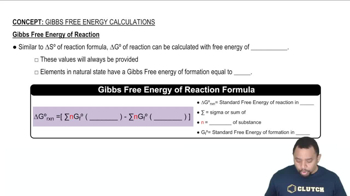
Gibbs Free Energy (ΔG)

Gibbs Free Energy (ΔG) is a thermodynamic potential that measures the maximum reversible work obtainable from a thermodynamic system at constant temperature and pressure. It is used to predict the spontaneity of a reaction: if ΔG is negative, the reaction is spontaneous; if positive, it is non-spontaneous. The relationship between ΔG, enthalpy (ΔH), and entropy (ΔS) is given by the equation ΔG = ΔH - TΔS, where T is the temperature in Kelvin.
Video consigliato:
Percorso guidato
01:51
Gibbs Free Energy of Reactions

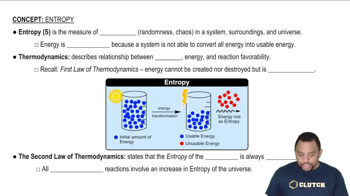
Enthalpy (ΔH) and Entropy (ΔS)

Enthalpy (ΔH) is a measure of the total heat content of a system, reflecting the energy required to break and form bonds during a reaction. Entropy (ΔS) quantifies the degree of disorder or randomness in a system. Together, these two properties influence the Gibbs Free Energy and thus the spontaneity of a reaction. A reaction with a negative ΔH and positive ΔS is more likely to be spontaneous.
Video consigliato:
Percorso guidato
02:46
Entropy in Thermodynamics

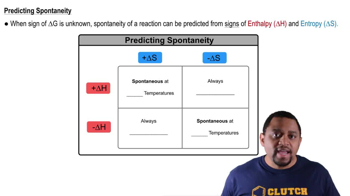
Temperature's Role in Spontaneity

Temperature plays a crucial role in determining the spontaneity of a reaction as it affects the balance between enthalpy and entropy. In the Gibbs Free Energy equation, increasing temperature (T) can enhance the impact of entropy (ΔS) on ΔG. Therefore, at higher temperatures, reactions with positive ΔS may become spontaneous even if ΔH is positive, as the TΔS term can outweigh ΔH.
Video consigliato:
Percorso guidato
01:17
Spontaneity and Temperature