Consider the reaction: CO2(g) + CCl4(g) ⇌ 2 COCl2(g) Calculate ΔG for this reaction at 25 °C under the following conditions: i. PCO2 = 0.112 atm ii. PCCl4 = 0.174 atm iii. PCOCl2 = 0.744 atm
Ch.18 - Free Energy and Thermodynamics
Tro4th EditionChemistry: A Molecular ApproachISBN: 9780134112831Non è quello che usi tu?Cambia libro di testo
Capitolo 18, Problema 71
Consider the reaction: CH3OH(g) → CO(g) + 2 H2(g). Calculate ΔG for this reaction at 25 °C under the following conditions: i. PCH3OH = 0.855 atm ii. PCO = 0.125 atm iii. PH2 = 0.183 atm.
Guida verificata passo dopo passo1
Concetti chiave
Ecco i concetti essenziali che devi comprendere per rispondere correttamente alla domanda.
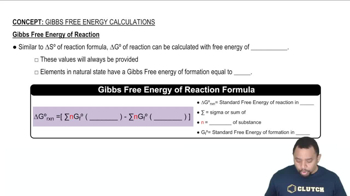
Gibbs Free Energy (ΔG)
Gibbs Free Energy (ΔG) is a thermodynamic potential that measures the maximum reversible work obtainable from a thermodynamic system at constant temperature and pressure. It is a crucial concept in predicting the spontaneity of a reaction; a negative ΔG indicates that a reaction can occur spontaneously, while a positive ΔG suggests non-spontaneity.
Video consigliato:
Percorso guidato
Gibbs Free Energy of Reactions
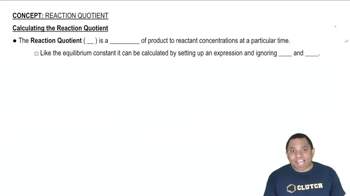
Reaction Quotient (Q)
The reaction quotient (Q) is a ratio that compares the concentrations or partial pressures of the products to the reactants at any point in a reaction. It is used to determine the direction in which a reaction will proceed to reach equilibrium. For the given reaction, Q can be calculated using the partial pressures of the gases involved.
Video consigliato:
Percorso guidato
Reaction Quotient Q
Standard Gibbs Free Energy Change (ΔG°)
The standard Gibbs free energy change (ΔG°) is the change in Gibbs free energy for a reaction under standard conditions (1 atm pressure, 25 °C). It serves as a reference point for calculating ΔG under non-standard conditions using the equation ΔG = ΔG° + RT ln(Q), where R is the gas constant and T is the temperature in Kelvin.
Video consigliato:
Percorso guidato
Standard Gibbs Free Energy and Temperature
Pratica correlata
Domanda del libro di testo
2712
views
1
comments
Domanda del libro di testo
Use data from Appendix IIB to calculate the equilibrium constants at 25 °C for each reaction. a. 2 CO(g) + O2(g) ⇌ 2 CO2(g)
2420
views
1
rank
Domanda del libro di testo
Consider the evaporation of methanol at 25.0 °C : CH3OH(l) → CH3OH(g) b. Find ΔGr at 25.0 °C under the following nonstandard conditions: i. PCH3OH = 150.0 mmHg ii. PCH3OH = 100.0 mmHg iii. PCH3OH = 10.0 mmHg
2431
views
Domanda del libro di testo
Consider the evaporation of methanol at 25.0 °C : CH3OH(l) → CH3OH(g) a. Find ΔG°r at 25.0 °C.
2543
views
Domanda del libro di testo
Consider the evaporation of methanol at 25.0 °C : CH3OH(l) → CH3OH(g) c. Explain why methanol spontaneously evaporates in open air at 25.0 °C
617
views
Domanda del libro di testo
Use data from Appendix IIB to calculate the equilibrium constants at 25 °C for each reaction. b. 2 H2S(g) ⇌ 2 H2(g) + S2(g)
551
views