Ch.18 - Free Energy and Thermodynamics
Tro - Chemistry: A Molecular Approach 4th Edition
Tro4th EditionChemistry: A Molecular ApproachISBN: 9780134112831Non è quello che usi tu?Cambia libro di testo
Capitolo 18, Problema 89c

Consider this reaction occurring at 298 K: N2O(g) + NO2(g) ⇌ 3 NO(g) c. Can the reaction be made more spontaneous by an increase or decrease in temperature? If so, what temperature is required to make the reaction spontaneous under standard conditions?

Guida verificata passo dopo passo
1
insert step 1> Determine the standard enthalpy change (\( \Delta H^\circ \)) and standard entropy change (\( \Delta S^\circ \)) for the reaction using standard thermodynamic tables.
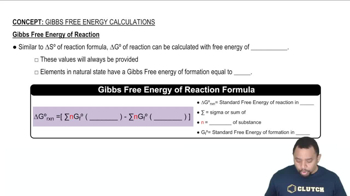
insert step 2> Use the Gibbs free energy equation \( \Delta G^\circ = \Delta H^\circ - T \Delta S^\circ \) to find the standard Gibbs free energy change (\( \Delta G^\circ \)) at 298 K.
insert step 3> Determine if the reaction is spontaneous at 298 K by checking if \( \Delta G^\circ < 0 \).
insert step 4> To find the temperature at which the reaction becomes spontaneous, set \( \Delta G^\circ = 0 \) and solve for temperature \( T \) using the equation \( T = \frac{\Delta H^\circ}{\Delta S^\circ} \).
insert step 5> Analyze whether increasing or decreasing the temperature will make the reaction more spontaneous based on the signs of \( \Delta H^\circ \) and \( \Delta S^\circ \).

Risposta video verificata per un problema simile:

Questa soluzione video è stata consigliata dai nostri tutor come utile per risolvere questo problema.
Durata del video:
8m

Concetti chiave

Ecco i concetti essenziali che devi comprendere per rispondere correttamente alla domanda.

Gibbs Free Energy

Gibbs Free Energy (G) is a thermodynamic potential that helps predict the spontaneity of a reaction at constant temperature and pressure. A reaction is spontaneous if the change in Gibbs Free Energy (ΔG) is negative. The relationship between ΔG, enthalpy (ΔH), and entropy (ΔS) is given by the equation ΔG = ΔH - TΔS, where T is the temperature in Kelvin.
Video consigliato:
Percorso guidato
01:51
Gibbs Free Energy of Reactions

Entropy and Enthalpy

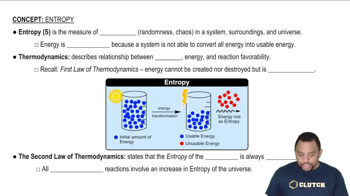
Entropy (S) is a measure of the disorder or randomness in a system, while enthalpy (H) is a measure of the total energy of a system, including internal energy and the energy required to make room for it. For a reaction to be spontaneous, the increase in entropy must outweigh the enthalpy changes, particularly at higher temperatures, where the TΔS term becomes significant in the Gibbs Free Energy equation.
Video consigliato:
Percorso guidato
02:46
Entropy in Thermodynamics

Temperature's Effect on Spontaneity

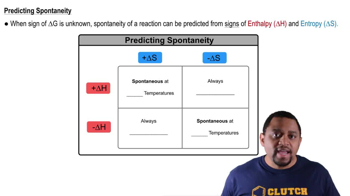
The temperature of a system can significantly influence the spontaneity of a reaction. If a reaction has a positive ΔS (increase in entropy), increasing the temperature can make the reaction more spontaneous by lowering ΔG. Conversely, if ΔH is positive (endothermic reaction), a higher temperature may be required to achieve a negative ΔG, thus making the reaction spontaneous under standard conditions.
Video consigliato:
Percorso guidato
01:17
Spontaneity and Temperature