Ch.18 - Free Energy and Thermodynamics
Tro - Chemistry: A Molecular Approach 4th Edition
Tro4th EditionChemistry: A Molecular ApproachISBN: 9780134112831Non è quello che usi tu?Cambia libro di testo
Capitolo 18, Problema 77

Is the value of the equilibrium constant at 525 K for each reaction in Problem 73 estimated correctly?

Guida verificata passo dopo passo
1
insert step 1> Identify the reactions from Problem 73 that need to be evaluated for their equilibrium constants at 525 K.
insert step 2> Review the method used to estimate the equilibrium constant for each reaction. This could involve calculations using the Van't Hoff equation or other thermodynamic data.
insert step 3> Check if the temperature dependence of the equilibrium constant was considered correctly. This often involves using the Van't Hoff equation: \( \ln \frac{K_2}{K_1} = -\frac{\Delta H^\circ}{R} \left( \frac{1}{T_2} - \frac{1}{T_1} \right) \), where \( \Delta H^\circ \) is the standard enthalpy change, \( R \) is the gas constant, and \( T_1 \) and \( T_2 \) are the initial and final temperatures, respectively.
insert step 4> Verify if the correct values for \( \Delta H^\circ \) and \( K_1 \) (the equilibrium constant at the initial temperature) were used in the calculations.
insert step 5> Compare the estimated equilibrium constants with any available experimental data or literature values to assess the accuracy of the estimates.

Concetti chiave

Ecco i concetti essenziali che devi comprendere per rispondere correttamente alla domanda.

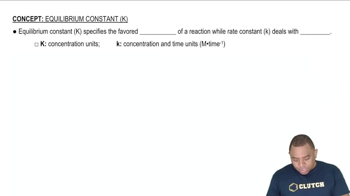
Equilibrium Constant (K)

The equilibrium constant (K) is a numerical value that expresses the ratio of the concentrations of products to reactants at equilibrium for a given reaction at a specific temperature. It provides insight into the extent of a reaction and whether it favors products or reactants. A larger K value indicates a greater concentration of products at equilibrium, while a smaller K suggests a predominance of reactants.
Video consigliato:
Percorso guidato
01:14
Equilibrium Constant K

Temperature Dependence of K

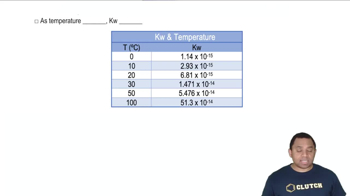
The value of the equilibrium constant is temperature-dependent, meaning it can change with variations in temperature. According to Le Chatelier's principle, if a reaction is exothermic, increasing the temperature will decrease the value of K, while for endothermic reactions, increasing temperature will increase K. Understanding this relationship is crucial for accurately estimating K at different temperatures.
Video consigliato:
Percorso guidato
01:24
Kw Temperature Dependence

Reaction Quotient (Q)

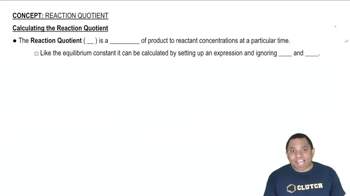
The reaction quotient (Q) is a measure of the relative concentrations of products and reactants at any point in time during a reaction. It is calculated using the same formula as K but with concentrations that are not necessarily at equilibrium. Comparing Q to K helps predict the direction in which a reaction will proceed to reach equilibrium, which is essential for evaluating the correctness of K values in specific conditions.
Video consigliato:
Percorso guidato
00:49
Reaction Quotient Q