Ch.18 - Free Energy and Thermodynamics
Tro - Chemistry: A Molecular Approach 4th Edition
Tro4th EditionChemistry: A Molecular ApproachISBN: 9780134112831Non è quello che usi tu?Cambia libro di testo
Capitolo 18, Problema 57

Find ΔS° for the formation of CH2Cl2(g) from its gaseous elements in their standard states. Rationalize the sign of ΔS°.

Guida verificata passo dopo passo
1
Identify the reaction for the formation of CH2Cl2(g) from its gaseous elements: C(graphite) + 2H2(g) + 2Cl2(g) -> CH2Cl2(g).
Use the standard entropy values (S°) for each substance involved in the reaction. These values are typically found in a table of thermodynamic data.
Calculate the change in entropy (ΔS°) for the reaction using the formula: ΔS° = ΣS°(products) - ΣS°(reactants).
Substitute the standard entropy values into the formula to find ΔS°.
Rationalize the sign of ΔS°: Consider the change in the number of moles of gas and the complexity of the molecules involved. Formation of CH2Cl2(g) from simpler gaseous elements may lead to a decrease in entropy due to a decrease in the number of gas molecules.

Risposta video verificata per un problema simile:

Questa soluzione video è stata consigliata dai nostri tutor come utile per risolvere questo problema.
Durata del video:
3m

Concetti chiave

Ecco i concetti essenziali che devi comprendere per rispondere correttamente alla domanda.

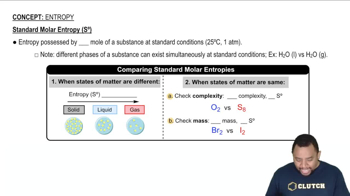
Standard Entropy (ΔS°)

Standard entropy (ΔS°) is a measure of the disorder or randomness of a system at standard conditions (1 bar, 25°C). It quantifies the amount of energy unavailable for doing work due to the dispersal of energy in a system. A positive ΔS° indicates an increase in disorder, while a negative ΔS° suggests a decrease in disorder.
Video consigliato:
Percorso guidato
03:33
Standard Molar Entropy

Formation Reaction

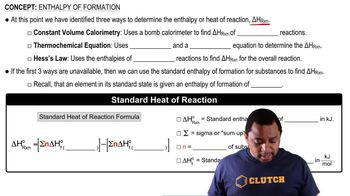
A formation reaction is a chemical reaction in which one mole of a compound is formed from its constituent elements in their standard states. For example, the formation of dichloromethane (CH2Cl2) involves combining carbon, hydrogen, and chlorine gases. The standard enthalpy and entropy changes for this reaction are crucial for calculating thermodynamic properties.
Video consigliato:
Percorso guidato
02:34
Enthalpy of Formation

Gibbs Free Energy and Spontaneity

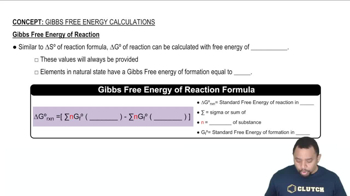
Gibbs free energy (G) combines enthalpy and entropy to determine the spontaneity of a reaction at constant temperature and pressure. The change in Gibbs free energy (ΔG) is given by the equation ΔG = ΔH - TΔS. A negative ΔG indicates a spontaneous process, while the sign of ΔS helps rationalize whether the reaction increases or decreases disorder, influencing the overall spontaneity.
Video consigliato:
Percorso guidato
01:51
Gibbs Free Energy of Reactions