Two systems, each composed of two particles represented by circles, have 20 J of total energy. Which system, A or B, has the greater entropy? Why?
Ch.18 - Free Energy and Thermodynamics
Tro4th EditionChemistry: A Molecular ApproachISBN: 9780134112831Non è quello che usi tu?Cambia libro di testo
Capitolo 18, Problema 28
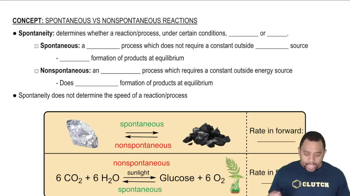
Which of these processes are nonspontaneous? Are the nonspontaneous processes impossible? a. a bike going up a hill b. a meteor falling to Earth c. obtaining hydrogen gas from liquid water d. a ball rolling down a hill
Guida verificata passo dopo passo1
1. A nonspontaneous process is one that does not occur naturally without the input of energy. It's important to note that nonspontaneous does not mean impossible, it just means that energy must be added to the system for the process to occur.
2. For option a, a bike going up a hill, this is a nonspontaneous process. It requires an input of energy (in this case, the cyclist's effort) to make the bike go uphill against the force of gravity.
3. For option b, a meteor falling to Earth, this is a spontaneous process. It happens naturally due to the force of gravity pulling the meteor towards the Earth.
4. For option c, obtaining hydrogen gas from liquid water, this is a nonspontaneous process. It requires an input of energy, usually in the form of electricity, to break the bonds in water molecules and form hydrogen gas.
5. For option d, a ball rolling down a hill, this is a spontaneous process. It happens naturally due to the force of gravity pulling the ball downhill.

Risposta video verificata per un problema simile:
Questa soluzione video è stata consigliata dai nostri tutor come utile per risolvere questo problema.
Durata del video:
1mConcetti chiave
Ecco i concetti essenziali che devi comprendere per rispondere correttamente alla domanda.
Spontaneity of Processes
A spontaneous process is one that occurs naturally under given conditions without the need for external energy. These processes tend to increase the overall entropy of the system and its surroundings. In contrast, nonspontaneous processes require energy input to occur, indicating that they do not favor the direction of change without assistance.
Video consigliato:
Percorso guidato
Spontaneity of Processes
Energy and Work
In chemistry, energy is the capacity to do work, and it plays a crucial role in determining whether a process is spontaneous or nonspontaneous. For example, moving a bike uphill requires work against gravitational forces, making it nonspontaneous. Understanding the relationship between energy, work, and spontaneity helps clarify why certain processes need energy input.
Video consigliato:
Percorso guidato
Work Function Calculation Example
Thermodynamics and Entropy
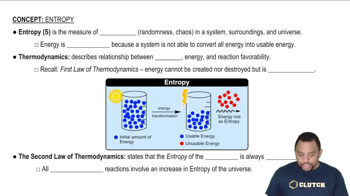
Thermodynamics is the study of energy transformations, and entropy is a measure of disorder in a system. Nonspontaneous processes often lead to a decrease in entropy, which is unfavorable in natural systems. By analyzing the changes in entropy and energy, one can determine the spontaneity of a process and whether it can occur without external influence.
Video consigliato:
Percorso guidato
Entropy in Thermodynamics
Pratica correlata
Domanda del libro di testo
418
views
Domanda del libro di testo
Which of these processes is spontaneous? a. the combustion of natural gas b. the extraction of iron metal from iron ore c. a hot drink cooling to room temperature d. drawing heat energy from the ocean's surface to power a ship
1126
views
Domanda del libro di testo
Calculate the change in entropy that occurs in the system when 1.00 mole of isopropyl alcohol (C3H8O) melts at its melting point (-89.5 °C). See Table 11.9 for heats of fusion.
2701
views
1
rank
1
comments
Domanda del libro di testo
Two systems, each composed of three particles represented by circles, have 30 J of total energy. How many energetically equivalent ways can you distribute the particles in each system? Which system has greater entropy?
1463
views