
Ch.19 - Electrochemistry
Tro - Chemistry: A Molecular Approach 4th Edition
Tro4th EditionChemistry: A Molecular ApproachISBN: 9780134112831Non è quello che usi tu?Cambia libro di testo
Capitolo 19, Problema 115a

A battery relies on the oxidation of magnesium and the reduction of Cu2+. The initial concentrations of Mg2+ and Cu2+ are 1.0 × 10⁻⁴ M and 1.5 M, respectively, in 1.0-liter half-cells. a. What is the initial voltage of the battery?

Guida verificata passo dopo passo
1
Step 1: Identify the half-reactions. The oxidation half-reaction is Mg -> Mg2+ + 2e-, and the reduction half-reaction is Cu2+ + 2e- -> Cu.
Step 2: Use the Nernst equation to calculate the cell potential. The Nernst equation is E = E0 - (RT/nF) * ln(Q), where E is the cell potential, E0 is the standard cell potential, R is the gas constant, T is the temperature in Kelvin, n is the number of moles of electrons transferred in the balanced redox reaction, F is the Faraday constant, and Q is the reaction quotient.
Step 3: Determine the standard cell potential (E0). This is the difference between the standard reduction potentials of the two half-reactions. You can find these values in a standard reduction potentials table. Remember that the standard reduction potential for the oxidation half-reaction should be reversed because it is an oxidation, not a reduction.
Step 4: Calculate the reaction quotient (Q). This is the ratio of the concentrations of the products to the reactants, each raised to the power of its stoichiometric coefficient in the balanced chemical equation. In this case, Q = [Mg2+] / [Cu2+].
Step 5: Substitute the known values into the Nernst equation and solve for E. Remember to convert the temperature to Kelvin if it is given in degrees Celsius.

Risposta video verificata per un problema simile:

Questa soluzione video è stata consigliata dai nostri tutor come utile per risolvere questo problema.
Durata del video:
5m

Concetti chiave

Ecco i concetti essenziali che devi comprendere per rispondere correttamente alla domanda.

Oxidation and Reduction

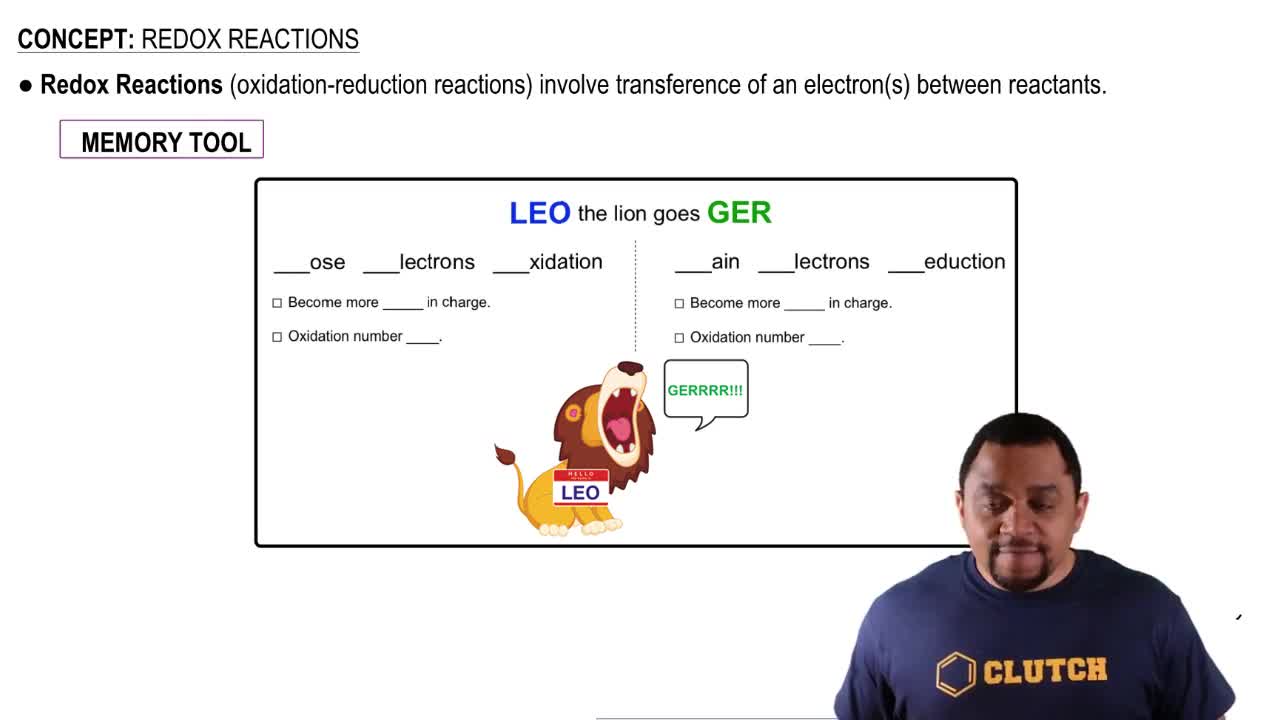
Oxidation and reduction are fundamental concepts in redox reactions, where oxidation refers to the loss of electrons and reduction refers to the gain of electrons. In the context of a battery, magnesium (Mg) is oxidized, losing electrons, while copper ions (Cu2+) are reduced, gaining those electrons. Understanding these processes is crucial for analyzing how batteries generate electrical energy.
Video consigliato:
Percorso guidato
01:53
Oxidation and Reduction Reactions

Nernst Equation

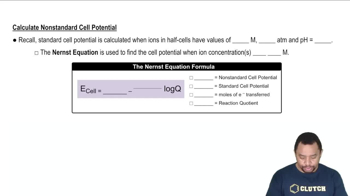
The Nernst equation relates the concentration of reactants and products in a redox reaction to the cell potential (voltage). It allows us to calculate the voltage of a battery under non-standard conditions by taking into account the concentrations of the oxidized and reduced species. This equation is essential for determining the initial voltage of the battery in the given problem.
Video consigliato:
Percorso guidato
01:17
The Nernst Equation

Standard Electrode Potentials

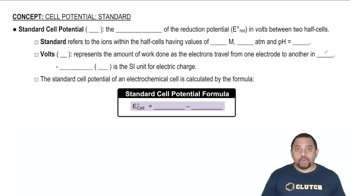
Standard electrode potentials are measured voltages for half-reactions under standard conditions (1 M concentration, 1 atm pressure, and 25°C). These values help predict the direction of electron flow in a redox reaction and the overall voltage of the battery. Knowing the standard potentials for the oxidation of magnesium and the reduction of copper ions is necessary to calculate the initial voltage of the battery.
Video consigliato:
Percorso guidato
01:27
Standard Cell Potential