
Ch.19 - Electrochemistry
Tro - Chemistry: A Molecular Approach 4th Edition
Tro4th EditionChemistry: A Molecular ApproachISBN: 9780134112831Non è quello che usi tu?Cambia libro di testo
Capitolo 19, Problema 81

A concentration cell consists of two Sn/Sn2+ half-cells. The cell has a potential of 0.10 V at 25°C. What is the ratio of the Sn2+ concentrations in the two half-cells?

Guida verificata passo dopo passo
1
Identify that the problem involves a concentration cell, which means the two half-cells are identical except for the concentration of the ions.
Use the Nernst equation for concentration cells: \(E_{cell} = \frac{RT}{nF} \ln \frac{[\text{Sn}^{2+}]_{\text{cathode}}}{[\text{Sn}^{2+}]_{\text{anode}}}\), where \(E_{cell}\) is the cell potential, \(R\) is the gas constant, \(T\) is the temperature in Kelvin, \(n\) is the number of moles of electrons transferred, and \(F\) is Faraday's constant.
Convert the temperature from Celsius to Kelvin: \(T = 25 + 273.15 = 298.15 \text{ K}\).
Substitute the given values into the Nernst equation: \(0.10 \text{ V} = \frac{(8.314 \text{ J/mol K})(298.15 \text{ K})}{(2)(96485 \text{ C/mol})} \ln \frac{[\text{Sn}^{2+}]_{\text{cathode}}}{[\text{Sn}^{2+}]_{\text{anode}}}\).
Solve for the ratio \(\frac{[\text{Sn}^{2+}]_{\text{cathode}}}{[\text{Sn}^{2+}]_{\text{anode}}}\) by isolating the natural logarithm and exponentiating both sides.

Risposta video verificata per un problema simile:

Questa soluzione video è stata consigliata dai nostri tutor come utile per risolvere questo problema.
Durata del video:
7m

Concetti chiave

Ecco i concetti essenziali che devi comprendere per rispondere correttamente alla domanda.

Nernst Equation

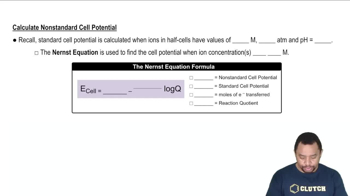
The Nernst Equation relates the cell potential to the concentrations of the reactants and products in an electrochemical cell. It is expressed as E = E° - (RT/nF) ln(Q), where E is the cell potential, E° is the standard cell potential, R is the gas constant, T is the temperature in Kelvin, n is the number of moles of electrons transferred, F is Faraday's constant, and Q is the reaction quotient. This equation is essential for calculating the potential of concentration cells.
Video consigliato:
Percorso guidato
01:17
The Nernst Equation

Concentration Cell

A concentration cell is a type of electrochemical cell where both half-cells contain the same species but at different concentrations. The potential difference arises from the difference in concentration, driving the spontaneous flow of electrons from the higher concentration to the lower concentration. Understanding this concept is crucial for analyzing how concentration differences can generate electrical energy.
Video consigliato:
Percorso guidato
01:21
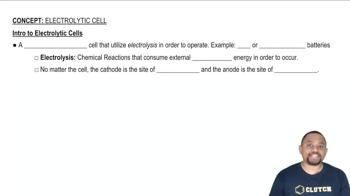
The Electrolytic Cell

Reaction Quotient (Q)

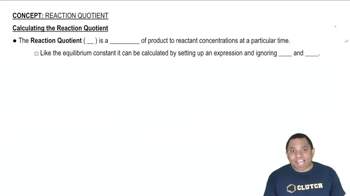
The reaction quotient (Q) is a measure of the relative concentrations of reactants and products at any point in a reaction. For a concentration cell involving Sn/Sn2+, Q is calculated as the ratio of the concentrations of Sn2+ in the two half-cells. This ratio is directly related to the cell potential, making it vital for determining the concentration difference that leads to the observed voltage.
Video consigliato:
Percorso guidato
00:49
Reaction Quotient Q