Ch.19 - Electrochemistry
Tro - Chemistry: A Molecular Approach 4th Edition
Tro4th EditionChemistry: A Molecular ApproachISBN: 9780134112831Non è quello che usi tu?Cambia libro di testo
Capitolo 19, Problema 124

A metal forms the fluoride MF3. Electrolysis of the molten fluo- ride by a current of 3.86 A for 16.2 minutes deposits 1.25 g of the metal. Calculate the molar mass of the metal.

Guida verificata passo dopo passo
1
Convert the time from minutes to seconds by multiplying 16.2 minutes by 60 seconds per minute.
Calculate the total charge passed during electrolysis using the formula: \( Q = I \times t \), where \( I \) is the current in amperes and \( t \) is the time in seconds.
Determine the number of moles of electrons transferred using Faraday's constant (\( F = 96485 \text{ C/mol} \)). Use the formula: \( \text{moles of electrons} = \frac{Q}{F} \).
Since the metal forms the fluoride MF3, each mole of metal requires 3 moles of electrons for reduction. Calculate the moles of the metal deposited using the relation: \( \text{moles of metal} = \frac{\text{moles of electrons}}{3} \).
Calculate the molar mass of the metal using the formula: \( \text{molar mass} = \frac{\text{mass of metal}}{\text{moles of metal}} \), where the mass of the metal is given as 1.25 g.

Risposta video verificata per un problema simile:

Questa soluzione video è stata consigliata dai nostri tutor come utile per risolvere questo problema.
Durata del video:
3m

Concetti chiave

Ecco i concetti essenziali che devi comprendere per rispondere correttamente alla domanda.

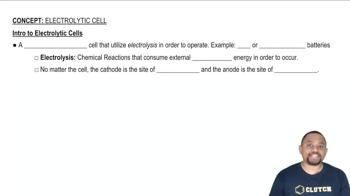
Electrolysis

Electrolysis is a chemical process that uses electrical energy to drive a non-spontaneous reaction. In this context, it involves passing an electric current through molten fluoride to decompose it into its constituent elements, allowing for the deposition of the metal. The amount of substance deposited can be calculated using Faraday's laws of electrolysis, which relate the quantity of electric charge to the amount of substance transformed.
Video consigliato:
Percorso guidato
01:21
The Electrolytic Cell

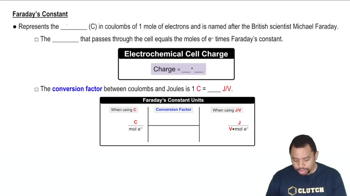
Faraday's Laws of Electrolysis

Faraday's laws state that the amount of substance deposited during electrolysis is directly proportional to the electric charge passed through the electrolyte. The first law quantifies this relationship, while the second law relates the amount of substance to its equivalent weight. These laws are essential for calculating the molar mass of the metal in the given problem, as they allow us to connect the current, time, and mass of the deposited metal.
Video consigliato:
Percorso guidato
01:40
Faraday's Constant in Electrochemistry

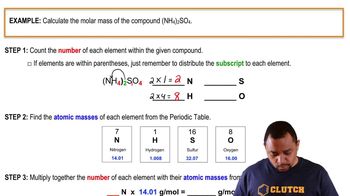
Molar Mass Calculation

Molar mass is defined as the mass of one mole of a substance, typically expressed in grams per mole (g/mol). To calculate the molar mass of the metal in this scenario, we first determine the number of moles of metal deposited using the mass and then apply the relationship between moles, charge, and the number of electrons transferred during electrolysis. This calculation is crucial for identifying the identity of the metal based on its molar mass.
Video consigliato:
Percorso guidato
03:12
Molar Mass Calculation Example